

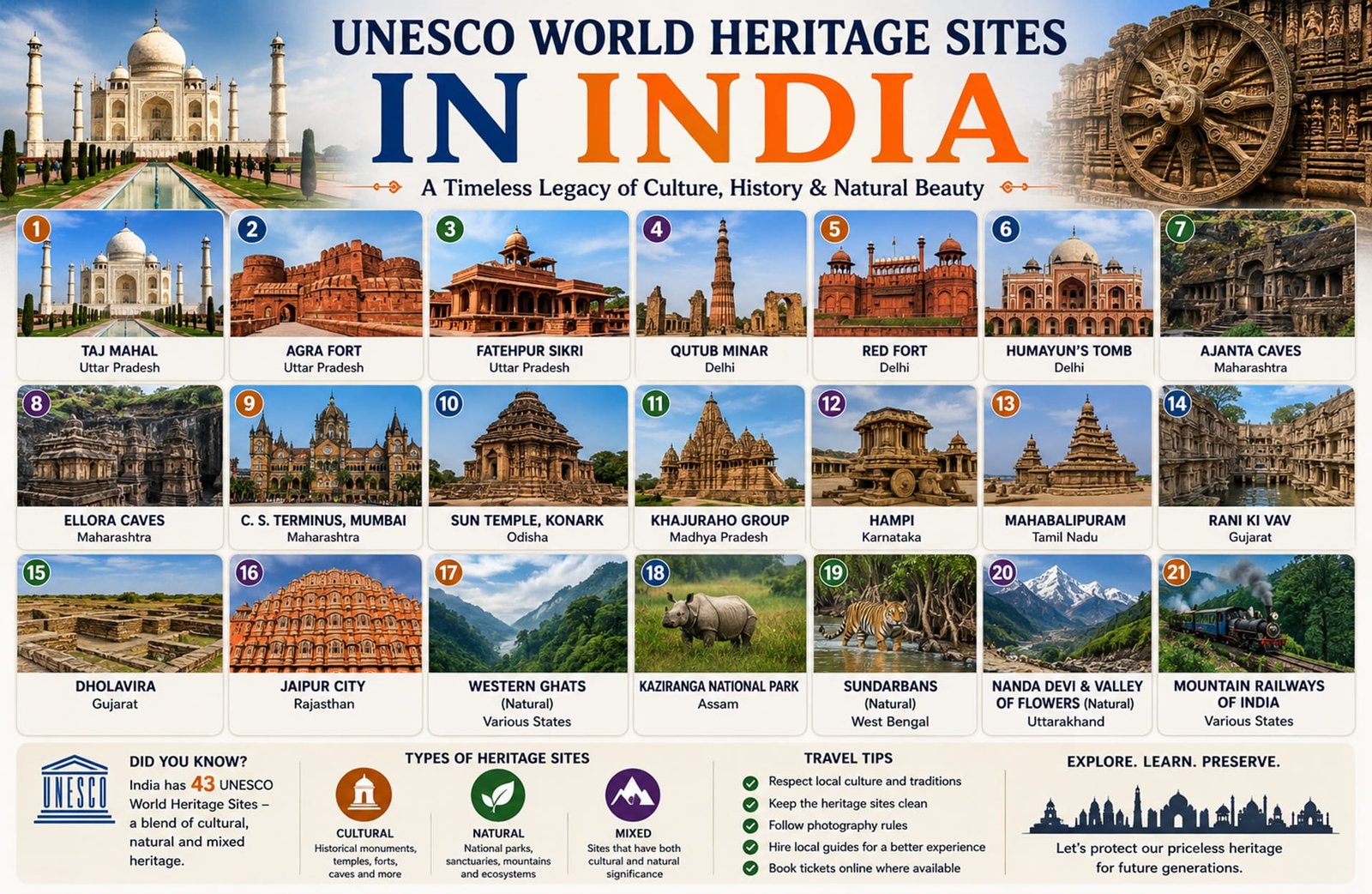
UNESCO World Heritage Sites in India
India is home to one of the richest cultural and natural heritages in the world. With 43 UNESCO World Heritage Sites (as of 2026), the country showcases magnificent monuments, ancient temples, archaeological ruins, spectacular national parks, mountain railways, and breathtaking natural landscapes.
From the timeless beauty of the Taj Mahal to the ancient rock-cut caves of Ajanta and Ellora, and from the wildlife-rich Kaziranga National Park to the architectural marvels of Hampi, every UNESCO site tells a unique story.
Whether you’re a history enthusiast, nature lover, photographer, or cultural explorer, these heritage sites offer unforgettable travel experiences.
What is a UNESCO World Heritage Site?
A UNESCO World Heritage Site is a place recognized by the United Nations Educational, Scientific and Cultural Organization (UNESCO) for its outstanding cultural, historical, scientific, or natural importance. These sites are protected for future generations because of their universal value.
India’s UNESCO sites are divided into three categories:
- Cultural Heritage Sites
- Natural Heritage Sites
- Mixed Heritage Sites
UNESCO World Heritage Sites in India
1. Taj Mahal (Uttar Pradesh)
The Taj Mahal is one of the Seven Wonders of the World and India’s most iconic monument.
Highlights
- White marble architecture
- Mughal craftsmanship
- UNESCO Site since 1983
- Sunrise and sunset views
2. Agra Fort (Uttar Pradesh)
A magnificent Mughal fort built with red sandstone.
Attractions
- Jahangiri Mahal
- Diwan-i-Khas
- Musamman Burj
3. Fatehpur Sikri (Uttar Pradesh)
Akbar’s abandoned Mughal capital.
Highlights
- Buland Darwaza
- Jama Masjid
- Panch Mahal
4. Qutub Minar (Delhi)
The world’s tallest brick minaret.
Must Visit
- Qutub Minar
- Iron Pillar
- Alai Darwaza
5. Red Fort (Delhi)
One of India’s most significant Mughal monuments.
Attractions
- Lahore Gate
- Diwan-i-Aam
- Rang Mahal
6. Humayun’s Tomb (Delhi)
India’s first grand garden tomb and an inspiration for the Taj Mahal.
7. Ajanta Caves (Maharashtra)


Famous for ancient Buddhist paintings and sculptures dating back over 2,000 years.
8. Ellora Caves (Maharashtra)
Home to Hindu, Buddhist, and Jain cave temples.
Highlight
- Kailasa Temple
9. Chhatrapati Shivaji Maharaj Terminus (Mumbai)
A masterpiece of Victorian Gothic architecture.
10. Elephanta Caves (Mumbai)
Known for magnificent rock-cut sculptures dedicated to Lord Shiva.
11. Victorian Gothic & Art Deco Ensemble of Mumbai
A remarkable collection of heritage buildings showcasing two architectural styles.
12. Champaner-Pavagadh Archaeological Park (Gujarat)
A blend of forts, temples, mosques, and archaeological remains.
13. Rani Ki Vav (Gujarat)
One of India’s finest stepwells featuring intricate carvings.
14. Dholavira (Gujarat)
Ancient city of the Indus Valley Civilization.
15. Sun Temple, Konark (Odisha)
Designed as a giant stone chariot dedicated to the Sun God.
16. Jagannath Temple Corridor (Nearby Attraction)
While the Jagannath Temple itself is not a UNESCO site, it is a major pilgrimage destination often combined with a visit to Konark and Puri.
17. Khajuraho Group of Monuments (Madhya Pradesh)


World-famous for beautifully carved temple sculptures.
18. Sanchi Stupa (Madhya Pradesh)
One of Buddhism’s oldest surviving monuments.
19. Bhimbetka Rock Shelters (Madhya Pradesh)
Ancient cave paintings dating back thousands of years.
20. Buddhist Monuments at Sanchi
An important Buddhist pilgrimage destination.
21. Hampi (Karnataka)
The spectacular ruins of the Vijayanagara Empire.
Attractions
- Virupaksha Temple
- Stone Chariot
- Lotus Mahal
- Vittala Temple
22. Pattadakal (Karnataka)
A remarkable collection of early Chalukyan temples.
23. Group of Monuments at Mahabalipuram (Tamil Nadu)
Known for rock-cut temples and the Shore Temple.
24. Great Living Chola Temples (Tamil Nadu)
Includes:
- Brihadeeswarar Temple
- Gangaikonda Cholapuram
- Airavatesvara Temple
25. Nilgiri Mountain Railway (Tamil Nadu)
Part of the UNESCO-listed Mountain Railways of India.
26. Mountain Railways of India
Includes:
- Darjeeling Himalayan Railway
- Nilgiri Mountain Railway
- Kalka-Shimla Railway
27. Churches and Convents of Goa
Historic Portuguese churches including the Basilica of Bom Jesus.
28. Kaziranga National Park (Assam)


Famous for the world’s largest population of one-horned rhinoceroses.
29. Manas Wildlife Sanctuary (Assam)
Known for tigers, elephants, and rich biodiversity.
30. Nanda Devi & Valley of Flowers National Parks (Uttarakhand)
A paradise of alpine flowers and Himalayan landscapes.
31. Great Himalayan National Park (Himachal Pradesh)
Home to rare Himalayan wildlife and scenic trekking trails.
32. Sundarbans National Park (West Bengal)
The world’s largest mangrove forest and home of the Royal Bengal Tiger.
33. Khangchendzonga National Park (Sikkim)
India’s only Mixed UNESCO World Heritage Site, celebrated for its dramatic Himalayan scenery, biodiversity, and cultural significance.
34. Jaipur City (Rajasthan)
The Pink City is renowned for its planned urban layout and royal heritage.
Attractions
- Hawa Mahal
- City Palace
- Jantar Mantar
- Albert Hall Museum
35. Jantar Mantar, Jaipur
The world’s largest stone astronomical observatory.
36. Ramappa Temple (Telangana)
A masterpiece of Kakatiya architecture known for its floating bricks.
37. Sacred Ensembles of the Hoysalas (Karnataka)
Includes:
- Chennakeshava Temple, Belur
- Hoysaleswara Temple, Halebidu
- Keshava Temple, Somanathapura
38. Santiniketan (West Bengal)
Founded by Nobel Laureate Rabindranath Tagore, Santiniketan is celebrated for its innovative educational philosophy and cultural heritage.
39. Moidams – The Mound-Burial System of the Ahom Dynasty (Assam)
A recently inscribed UNESCO World Heritage Site showcasing the royal burial traditions of the Ahom Kingdom.
UNESCO Natural Heritage Sites in India
| Site | State |
|---|---|
| Kaziranga National Park | Assam |
| Manas Wildlife Sanctuary | Assam |
| Nanda Devi National Park | Uttarakhand |
| Valley of Flowers National Park | Uttarakhand |
| Great Himalayan National Park | Himachal Pradesh |
| Sundarbans National Park | West Bengal |
| Khangchendzonga National Park | Sikkim |
Best Time to Visit
| Season | Months | Best For |
|---|---|---|
| Winter | October – March | Sightseeing and pleasant weather |
| Summer | April – June | Hill heritage sites |
| Monsoon | July – September | Lush landscapes and waterfalls |
Suggested 15-Day UNESCO Heritage Tour
Days 1–3
- Delhi
- Qutub Minar
- Red Fort
- Humayun’s Tomb
Days 4–5
- Agra
- Taj Mahal
- Agra Fort
- Fatehpur Sikri
Days 6–7
- Khajuraho
- Sanchi
Days 8–9
- Hampi
Days 10–11
- Mahabalipuram
- Great Living Chola Temples
Days 12–13
- Jaipur
- Jantar Mantar
Days 14–15
- Kaziranga National Park or Sundarbans
Travel Tips
✔ Book entry tickets online for popular monuments where available.
✔ Hire certified local guides to better understand the history.
✔ Visit monuments early in the morning to avoid crowds.
✔ Wear comfortable footwear for archaeological sites.
✔ Respect heritage conservation rules and avoid touching ancient structures.
✔ Carry water, sunscreen, and a camera for long sightseeing days.
Frequently Asked Questions (FAQs)
How many UNESCO World Heritage Sites are there in India?
India has 43 UNESCO World Heritage Sites (as of 2026), including cultural, natural, and mixed heritage sites.
Which is India’s most famous UNESCO World Heritage Site?
The Taj Mahal is India’s most iconic UNESCO World Heritage Site.
Which state has the highest number of UNESCO World Heritage Sites?
Maharashtra, Tamil Nadu, Karnataka, and Uttar Pradesh are among the states with the highest concentration of UNESCO-listed sites.
Which is India’s only mixed UNESCO World Heritage Site?
Khangchendzonga National Park in Sikkim is India’s first and only mixed World Heritage Site.
Which UNESCO site is best for wildlife lovers?
Kaziranga National Park, Sundarbans National Park, Manas Wildlife Sanctuary, and the Great Himalayan National Park are excellent choices.
Vietnam Tour
Conclusion
India’s UNESCO World Heritage Sites represent thousands of years of history, art, architecture, religion, and natural beauty. From the timeless elegance of the Taj Mahal and the ancient universities of the past to wildlife-rich national parks and spectacular temple complexes, each site reflects the country’s incredible diversity and heritage.
Whether you’re planning a cultural vacation, a spiritual pilgrimage, or a wildlife adventure, exploring India’s UNESCO World Heritage Sites promises a memorable journey through one of the world’s richest civilizations.
Read More
- Best Spiritual Destinations in India
- Famous Tourist Places in Uttar Pradesh
- Famous Tourist Places in Bihar
- Beautiful Places to Visit in Madhya Pradesh
- Best Hill Stations in India