

Famous Places to Visit in Delhi – Top Tourist Attractions
Delhi is a city where ancient monuments, colourful markets, spiritual centres, landscaped gardens and modern neighbourhoods exist side by side. Travellers can explore centuries-old Mughal architecture in Old Delhi, admire grand government buildings in New Delhi and enjoy food and shopping experiences representing almost every region of India.
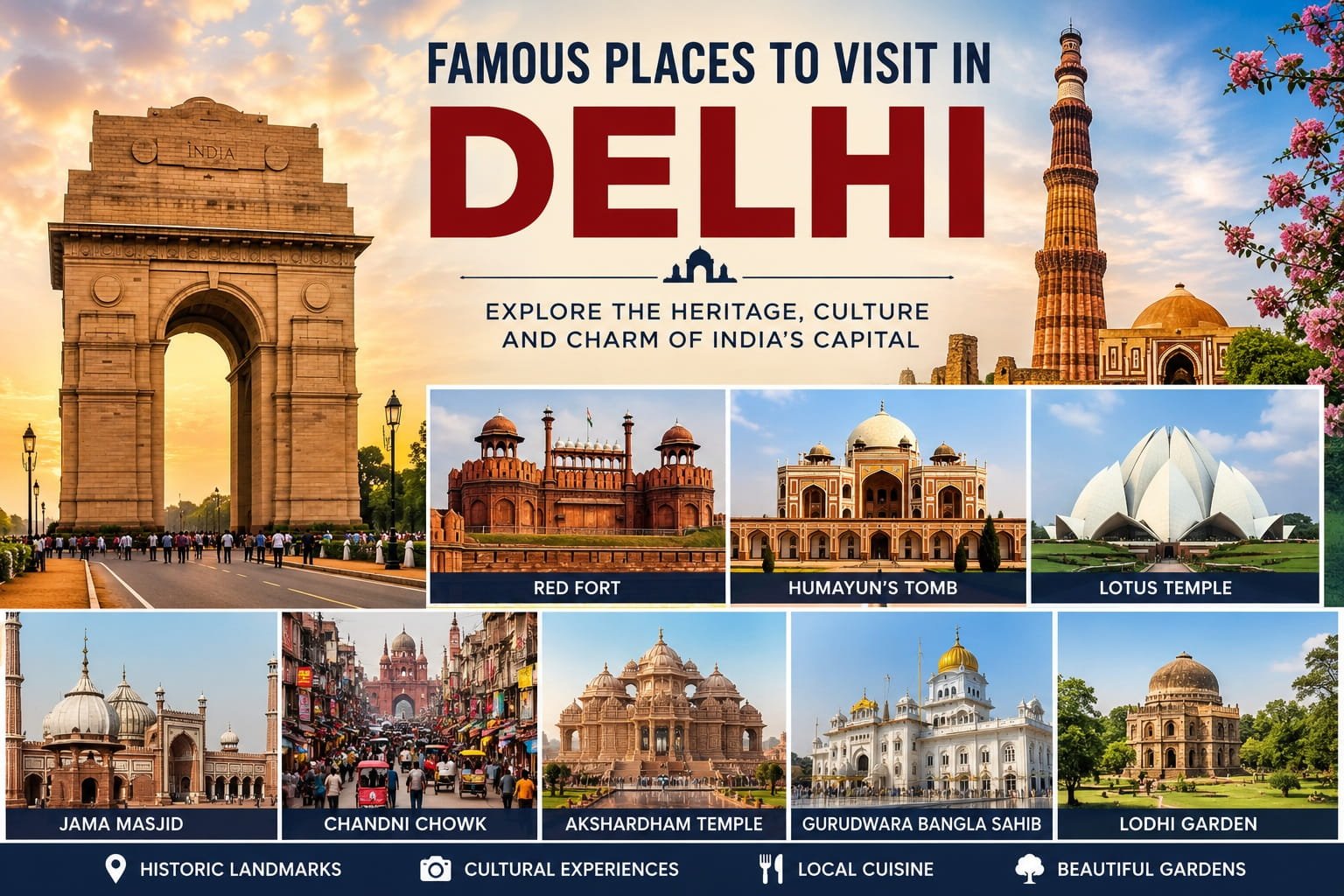
The capital is home to three UNESCO World Heritage Sites: the Red Fort Complex, Humayun’s Tomb and the Qutub Minar complex. Its broader attraction list includes India Gate, Jama Masjid, Lotus Temple, Akshardham, Dilli Haat, Lodhi Garden and Gurudwara Bangla Sahib.
Delhi Tour
Top Famous Places to Visit in Delhi
| Tourist attraction | Famous for | Recommended time |
|---|---|---|
| India Gate | National memorial and evening views | 1–2 hours |
| Red Fort | Mughal architecture and museums | 2–3 hours |
| Qutub Minar | UNESCO-listed medieval complex | 2 hours |
| Humayun’s Tomb | Mughal garden-tomb architecture | 1–2 hours |
| Lotus Temple | Lotus-shaped architecture and meditation | 1–2 hours |
| Akshardham Temple | Spiritual campus and cultural exhibitions | 3–5 hours |
| Jama Masjid | Historic mosque and Old Delhi views | 1 hour |
| Chandni Chowk | Markets and street food | 2–4 hours |
| Gurudwara Bangla Sahib | Sikh heritage and community kitchen | 1–2 hours |
| Lodhi Garden | Historic tombs and green spaces | 1–2 hours |
| Dilli Haat INA | Handicrafts and regional food | 2–3 hours |
| Raj Ghat | Memorial to Mahatma Gandhi | 45–60 minutes |
1. India Gate and Kartavya Path
India Gate is one of the most recognisable landmarks in Delhi. Designed by Sir Edwin Lutyens, the monumental arch commemorates Indian soldiers who died during the First World War and the Third Anglo-Afghan War.
The surrounding lawns and broad ceremonial avenue make this area particularly attractive in the evening. Visitors can walk along Kartavya Path, view the fountains and continue toward the Parliament and Rashtrapati Bhavan area. India Gate is especially impressive after sunset when the monument is illuminated.
Best for: Families, evening walks and photography
Suggested visiting time: Late afternoon or evening
Entry: Free
2. Red Fort
The Red Fort, also known as Lal Qila, is one of Delhi’s most important historic monuments. Constructed during the reign of Mughal emperor Shah Jahan, the complex served as the principal residence of the Mughal rulers after the imperial capital moved to Shahjahanabad.
Its red-sandstone walls enclose gateways, audience halls, royal apartments and landscaped spaces. The Red Fort Complex was added to UNESCO’s World Heritage List in 2007 and remains one of the strongest symbols of Mughal Delhi.
Set aside at least two hours to explore the complex. Pair the visit with Jama Masjid and Chandni Chowk, which are nearby. Operating hours and museum access may change on national events or maintenance days, so check the official ASI information before travelling.
Best for: History, Mughal architecture and museums
Nearest area: Chandni Chowk and Old Delhi
Important tip: Arrive early to avoid long queues and midday heat.
3. Qutub Minar
Qutub Minar is the centrepiece of a large archaeological complex in Mehrauli. The red-sandstone tower rises approximately 72.5 metres and was constructed in stages beginning in the early 13th century.
The surrounding complex contains the Quwwat-ul-Islam Mosque, Alai Darwaza, the Iron Pillar, the unfinished Alai Minar and several tombs and ruins. UNESCO recognises the site for its architectural and historical importance.
The monument is generally open from sunrise to sunset, although timings can vary seasonally. Early morning offers cooler weather, softer photography light and fewer visitors.
Best for: Architecture, history and photography
Recommended duration: Around two hours
Nearest metro: Qutub Minar
4. Humayun’s Tomb
Humayun’s Tomb is one of the finest examples of early Mughal architecture in India. Surrounded by a symmetrical charbagh garden, the mausoleum introduced architectural ideas later developed on an even grander scale at the Taj Mahal.
UNESCO describes it as the first important example of its architectural type in India and a major symbol of the Mughal dynasty. The main building is crowned by a 42.5-metre double dome and surrounded by smaller historic structures.
The peaceful gardens and red-and-white façade make Humayun’s Tomb one of the best places for photography in Delhi. Nearby attractions include Sunder Nursery, Nizamuddin Dargah and the National Crafts Museum.
Best for: Couples, architecture enthusiasts and photographers
Recommended time: Morning or shortly before sunset
Suggested duration: 1–2 hours
5. Lotus Temple
The Lotus Temple is a Bahá’í House of Worship known for its flower-inspired white-marble design. Its structure resembles a half-open lotus and uses repeating groups of nine throughout its architecture.
People of every faith and nationality are welcome to enter the prayer hall for silence, prayer or meditation. The temple complex covers approximately 26.5 acres and includes landscaped grounds and reflecting pools.
The official visitor information currently lists public opening from Tuesday to Sunday, 8:30 a.m. to 6:00 p.m. Visitors should confirm the day’s schedule before arrival, especially around holidays or special events.
Best for: Architecture, spirituality and peaceful surroundings
Entry: Free
Nearest metro: Kalkaji Mandir
6. Swaminarayan Akshardham
Swaminarayan Akshardham is a Hindu spiritual and cultural campus featuring an intricately carved mandir, landscaped gardens, exhibitions, a food court and an evening water show.
The complex is dedicated to devotion, learning, Indian culture and harmony. Visitors can explore the main temple, attend exhibitions or reserve additional time for the musical fountain experience.
Security rules are strict. Mobile phones, cameras and many electronic devices must be deposited before entering, and photography is restricted inside the complex. The campus normally opens at 10:00 a.m. and remains closed on Mondays, but visitors should verify current schedules and show timings before travelling.
Best for: Families, culture and spiritual experiences
Recommended duration: 3–5 hours
Nearest metro: Akshardham
7. Jama Masjid
Jama Masjid is one of the most significant landmarks in Old Delhi. Commissioned by Mughal emperor Shah Jahan, it was built between 1644 and 1656 using red sandstone and white marble.
Its enormous courtyard can accommodate thousands of worshippers, while its minarets and elevated position offer views across the dense neighbourhoods of Old Delhi. Delhi Tourism describes it as one of India’s largest mosques.
Visitors should dress modestly, remove their shoes before entering designated areas and avoid interrupting prayers. Tourist access may pause during prayer times. The surrounding lanes are also famous for Mughlai dishes, kebabs, breads, sweets and traditional street food.
Best for: Religious heritage, Old Delhi views and food exploration
Recommended duration: About one hour
Nearest metro: Jama Masjid or Chawri Bazar
8. Chandni Chowk
No Delhi trip is complete without experiencing Chandni Chowk. This historic market district is filled with narrow lanes, jewellery shops, textile traders, spice sellers, religious buildings and legendary food outlets.
Popular sections include Dariba Kalan for silver jewellery, Khari Baoli for spices and Paranthe Wali Gali for traditional snacks. The area can feel crowded and chaotic, but it offers one of the city’s most memorable cultural experiences.
Delhi Tourism recommends exploring the lanes of Old Delhi on foot or by cycle-rickshaw. Chandni Chowk can easily be combined with the Red Fort, Jama Masjid, Sis Ganj Gurudwara and nearby Jain temples.
Best for: Food, shopping, heritage walks and street photography
Recommended duration: 2–4 hours
Travel tip: Carry minimal valuables and keep bags closed in crowded lanes.
9. Gurudwara Bangla Sahib
Gurudwara Bangla Sahib is among Delhi’s most important Sikh places of worship. Its white façade, golden dome and sacred pool create a peaceful contrast to the busy roads surrounding Connaught Place.
The site is associated with Guru Har Krishan, the eighth Sikh Guru, who stayed at the former bungalow during the 17th century.
Visitors of every religion are welcome. Cover your head, remove your shoes and wash your feet before entering. You may also visit the community kitchen, or langar, where free vegetarian meals are served.
Best for: Spirituality, Sikh heritage and peaceful reflection
Entry: Free
Nearest metro: Patel Chowk or Rajiv Chowk
10. Lodhi Garden
Lodhi Garden is a landscaped public park containing tombs and architectural remains from the Sayyid and Lodhi periods. It is popular with morning walkers, photographers, families and travellers looking for a peaceful break between sightseeing stops.
The garden combines lawns, trees, water features and historic structures, making it an excellent place for an early-morning walk or relaxed picnic. Delhi Tourism includes Lodhi Garden among the important attractions accessible from the central New Delhi area. (Delhi Tourism)
Best for: Nature, walking, picnics and photography
Entry: Free
Recommended time: Early morning or late afternoon
11. Dilli Haat INA
Dilli Haat INA is an open-air cultural market featuring handicrafts, handloom products and food from different Indian states. Unlike a conventional street market, it is organised around rotating artisan stalls and permanent regional food counters.
Delhi Tourism developed the market with support from government textile and tourism bodies. It is located opposite INA Market in South Delhi.
This is a convenient place to buy textiles, jewellery, pottery, paintings, leather goods and souvenirs while sampling dishes from several regions of India.
Best for: Shopping, Indian cuisine and handicrafts
Recommended duration: 2–3 hours
Nearest metro: Dilli Haat–INA
12. Raj Ghat
Raj Ghat is the memorial dedicated to Mahatma Gandhi. A simple black-marble platform marks the place where he was cremated in January 1948.
The memorial is surrounded by gardens and usually maintains a quiet, respectful atmosphere. Visitors should remove footwear before approaching the central memorial area.
Raj Ghat is close to the Red Fort and can be included in an Old Delhi sightseeing itinerary.
Best for: History, reflection and landscaped gardens
Entry: Free
Recommended duration: 45–60 minutes
Best Time to Visit Delhi
Delhi Tourism recommends visiting between October and March, when the weather is generally more suitable for sightseeing. February and March are particularly pleasant for gardens, walking tours and outdoor monuments.
April to June can be extremely hot, while July to September brings monsoon rain and humidity. During warmer months, schedule outdoor monuments early in the morning and keep museums, temples or shopping areas for the afternoon.
Suggested Two-Day Delhi Itinerary
Day 1: Old Delhi and Central Delhi
Begin at the Red Fort, continue to Jama Masjid and explore Chandni Chowk by foot or cycle-rickshaw. After lunch, visit Raj Ghat. Spend the evening at India Gate and Kartavya Path.
Day 2: South and East Delhi
Start early at Qutub Minar, followed by Lotus Temple and Humayun’s Tomb. In the evening, choose between Akshardham’s cultural experiences or shopping and dinner at Dilli Haat INA.
How to Travel Around Delhi
The Delhi Metro is generally the most convenient way to travel between major neighbourhoods and tourist areas. Delhi Tourism provides metro-based itineraries linking Chandni Chowk with Old Delhi attractions and Central Secretariat with India Gate, museums, Lodhi Garden and other central landmarks.
Auto-rickshaws and app-based taxis are useful for the final distance between a metro station and an attraction. Allow extra travel time during weekday rush hours.
Essential Delhi Travel Tips
Wear comfortable shoes because large monuments involve considerable walking. Carry drinking water, sunscreen and a hat, especially outside winter. Dress modestly at mosques, temples and gurudwaras, and follow photography restrictions.
Book monument tickets through official platforms whenever advance booking is available. Keep small cash for local markets, shoe counters and minor purchases, although digital payments are widely accepted.
Check official attraction websites shortly before travelling because entry fees, weekly closing days, security rules and opening hours can change.
Frequently Asked Questions
Which are the most famous places to visit in Delhi?
India Gate, Red Fort, Qutub Minar, Humayun’s Tomb, Lotus Temple, Akshardham, Jama Masjid, Chandni Chowk and Gurudwara Bangla Sahib are among Delhi’s most famous attractions. Delhi Tourism also highlights Dilli Haat, Lodhi monuments, Purana Qila and Safdarjung’s Tomb.
How many days are enough for Delhi sightseeing?
Two full days are enough to see the major landmarks, while three or four days allow time for museums, markets, food walks and less-crowded heritage sites.
Which places in Delhi have free entry?
India Gate, Lodhi Garden, Raj Ghat, Gurudwara Bangla Sahib and Lotus Temple generally offer free entry. Special exhibitions, parking or additional experiences may have separate charges.
Which Delhi attractions are UNESCO World Heritage Sites?
The Red Fort Complex, Humayun’s Tomb and Qutub Minar and its Monuments are UNESCO World Heritage Sites in Delhi.
What is the best place to visit in Delhi at night?
India Gate and Kartavya Path are popular after sunset. Connaught Place is another convenient option for evening dining and shopping.
Is Delhi suitable for a family trip?
Yes. India Gate, Akshardham, the National Rail Museum, Dilli Haat, Lodhi Garden and the Garden of Five Senses are particularly suitable for family outings.
Final Thoughts
Delhi is far more than a gateway to other North Indian destinations. Its monuments reveal the stories of sultanates, Mughal emperors, colonial planners and independent India, while its markets, religious sites and food lanes show the city’s living culture.
A well-planned trip should combine major landmarks such as the Red Fort, Qutub Minar and Humayun’s Tomb with experiences like an Old Delhi food walk, an evening at India Gate, quiet time at Lotus Temple and handicraft shopping at Dilli Haat. Together, these places offer a memorable introduction to the history, diversity and energy of India’s capital.