
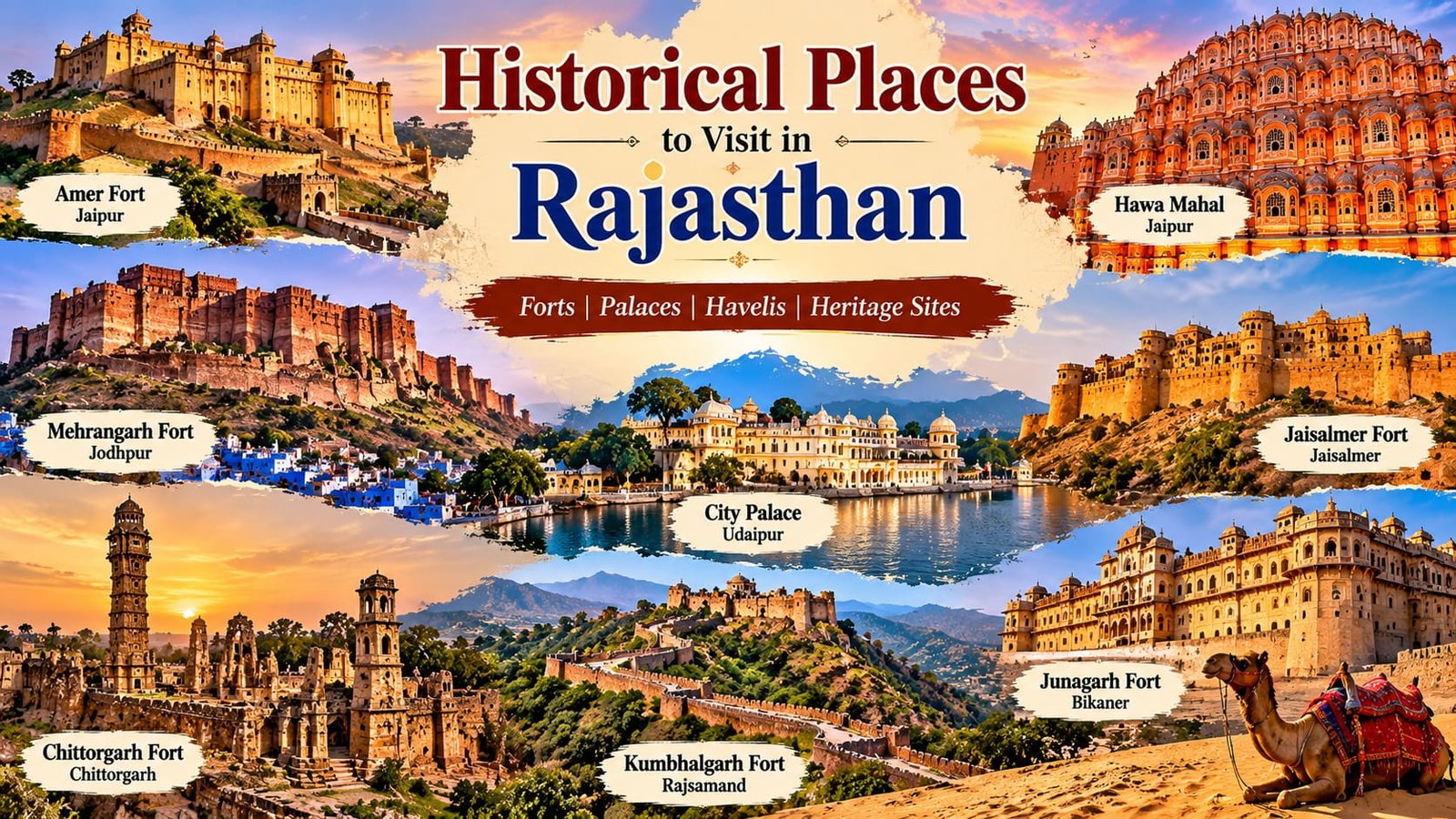
Rajasthan is one of India’s richest destinations for history and architecture. Massive hill forts rise above desert cities, royal palaces overlook lakes, centuries-old havelis line old bazaars, and temples and stepwells preserve stories from the Rajput kingdoms and later eras.
Six of Rajasthan’s great forts—Chittorgarh, Kumbhalgarh, Ranthambore, Gagron, Amer and Jaisalmer—are collectively inscribed on UNESCO’s World Heritage List as the Hill Forts of Rajasthan. UNESCO notes that these fortified centres reflect the power and courtly culture of Rajput states between roughly the 8th and 18th centuries.
For travellers interested in architecture, royal history, photography or cultural tourism, these are some of the best historical places to visit in Rajasthan.
Best Historical Places in Rajasthan at a Glance
| Historical Place | City/Region | Famous For |
|---|---|---|
| Amer Fort | Jaipur | Rajput-Mughal architecture |
| Hawa Mahal | Jaipur | Iconic five-storey façade |
| Nahargarh Fort | Jaipur | Jaipur views & royal retreat |
| Mehrangarh Fort | Jodhpur | Massive hilltop fortress |
| Jaisalmer Fort | Jaisalmer | Living desert fort |
| Chittorgarh Fort | Chittorgarh | Rajput history & monumental ruins |
| Kumbhalgarh Fort | Rajsamand | Huge fort walls & Mewar history |
| City Palace | Udaipur | Royal palace complex |
| Junagarh Fort | Bikaner | Red sandstone palaces |
| Ranthambore Fort | Sawai Madhopur | Forest hill fort |
| Gagron Fort | Jhalawar | River-protected fort |
| Bundi Palace & Taragarh | Bundi | Murals & hilltop architecture |
| Bhangarh Fort | Alwar region | 17th-century ruins |
| Jantar Mantar | Jaipur | Historic astronomical observatory |
| Patwon Ki Haveli | Jaisalmer | Ornate merchant architecture |
1. Amer Fort, Jaipur
Amer Fort, often called Amber Fort, is one of Rajasthan’s most impressive royal complexes.
Rajasthan Tourism describes Amer as the former capital of Dhundhar and notes that the fort-palace was developed by Raja Man Singh in the 16th century. Its architecture uses pale yellow and pink sandstone together with white marble.
Inside, visitors encounter courtyards, audience halls, gateways and beautifully decorated royal spaces.
The fort is particularly famous for Sheesh Mahal, whose mirrored interior is among Jaipur’s most recognizable architectural attractions.
Amer is also part of UNESCO’s Hill Forts of Rajasthan inscription.
Best for: Architecture, photography and first-time Rajasthan visitors
Recommended time: 2–3 hours
2. Hawa Mahal, Jaipur
Few buildings symbolize Rajasthan as instantly as the Hawa Mahal.
This five-storey Jaipur landmark was built in 1799 by Maharaja Sawai Pratap Singh. Rajasthan Tourism explains that its distinctive façade allowed women of the royal household to observe street life and processions while remaining screened from public view.
Its honeycomb-like arrangement of small windows and jharokhas gives the monument its famous appearance.
The Hawa Mahal works particularly well as part of a walking tour through Jaipur’s old city because it sits close to the City Palace, Jantar Mantar and historic markets.
Best for: Architecture, photography and Jaipur heritage walks
3. Nahargarh Fort, Jaipur
Perched along the Aravalli ridge above Jaipur, Nahargarh Fort offers a very different experience from Amer.
The fort was constructed during the reign of Sawai Jai Singh in 1734 and later expanded. Rajasthan Tourism notes that it served as an important defensive barrier overlooking Jaipur.
Inside lies Madhavendra Bhawan, with suites traditionally associated with the royal family.
Today, the fort is especially popular around sunset because of the wide views over Jaipur.
Best for: Sunset, city views and royal architecture
Recommended time: 1–2 hours
4. Mehrangarh Fort, Jodhpur
Rising dramatically above Jodhpur’s Blue City, Mehrangarh Fort is among India’s most spectacular fortifications.
Rajasthan Tourism describes it as rising from a rocky hill about 120 metres above the city, with massive defensive walls that visually merge with the rock below.
The fort complex contains royal courtyards, palaces, galleries and museum collections that help visitors understand the history of the Rathore rulers of Marwar.
From the ramparts, the blue-painted houses of old Jodhpur stretch across the landscape below.
Best for: Fort architecture, museums, photography and panoramic views
Recommended time: 3 hours
5. Jaisalmer Fort
Rising from the Thar Desert like a giant sandstone crown, Jaisalmer Fort is unlike most other forts in Rajasthan.
It remains a living urban settlement, with homes, shops, temples and guesthouses inside its historic walls.
UNESCO identifies Jaisalmer as an important example of a desert hill fort and highlights the continuing township and its Jain temples as part of what makes the site distinctive.
Its golden sandstone changes tone throughout the day, which is why Jaisalmer is often called the Golden City.
Walking through its narrow lanes can feel more like entering a medieval neighbourhood than visiting a conventional monument.
Best for: Desert heritage, Jain architecture and street photography
6. Chittorgarh Fort
If you want to understand the scale of Rajput history in Rajasthan, Chittorgarh Fort is essential.
UNESCO describes Chittorgarh as a former capital of the Sisodia clan and emphasizes its connection with famous sieges and Rajput history. The site contains architectural remains spanning several centuries.
Within the huge fortified area are palaces, towers, temples and water structures.
Notable attractions include Vijay Stambh, Kirti Stambh, Rana Kumbha Palace and the Padmini Palace area.
Rajasthan Tourism describes Chittorgarh as a city that epitomizes Rajput valour, pride and romance.
Best for: History enthusiasts and architecture
Recommended time: Half day
7. Kumbhalgarh Fort
Surrounded by the Aravalli hills, Kumbhalgarh Fort is one of Mewar’s great defensive monuments.
Rajasthan Tourism states that the fort was built in the 15th century by Rana Kumbha and describes it as the second most important Mewar citadel after Chittorgarh.
Its defensive wall extends for roughly 36 kilometres, according to Rajasthan Tourism, and the fort complex contains temples, palaces and panoramic viewpoints.
The site is also traditionally associated with the birthplace of Maharana Pratap.
Kumbhalgarh is part of the UNESCO Hill Forts of Rajasthan group.
Best for: Road trips, mountain scenery and Mewar history
8. City Palace, Udaipur
Overlooking Lake Pichola, the City Palace of Udaipur is one of Rajasthan’s most impressive palace complexes.
Rajasthan Tourism describes it as a vast collection of courtyards, pavilions, terraces, corridors, rooms and hanging gardens.
Particularly notable areas include Mor Chowk, famous for its peacock mosaics, and Chini Chitrashala with decorative ceramics.
The palace also offers striking views toward Lake Pichola and the surrounding city.
Udaipur itself was founded by Maharana Udai Singh II in the 16th century as the new capital of Mewar.
Best for: Palaces, museums and lake views
Recommended time: 2–3 hours
9. Junagarh Fort, Bikaner
Unlike many major Rajasthani forts, Junagarh Fort was built on relatively level ground rather than atop a major hill.
Rajasthan Tourism dates the fort to 1588, when it was built by Raja Rai Singh, a general in Emperor Akbar’s service.
The complex combines red sandstone and marble and contains elaborate courtyards, balconies, windows and palace interiors.
Incredible India highlights several important spaces inside, including Karan Mahal, Phool Mahal, Anup Mahal and Chandra Mahal.
Best for: Decorative interiors, museums and Bikaner history
10. Ranthambore Fort
Most travellers visit Sawai Madhopur for tigers, but Ranthambore Fort adds a major historical dimension to a wildlife trip.
The fort stands above the landscape now protected as Ranthambore National Park.
UNESCO identifies Ranthambore as an important example of a forest hill fort, noting that the remains of Hammir’s palace are among the oldest surviving examples of palace architecture within the six-fort World Heritage group.
The fort’s temples, gateways and elevated viewpoints make it worth visiting even if your primary reason for being in Ranthambore is a safari.
Best for: History + wildlife itineraries
11. Gagron Fort, Jhalawar
Gagron Fort is one of the less crowded UNESCO-listed forts in Rajasthan.
Its location is particularly unusual because rivers and surrounding terrain form part of its natural defenses.
UNESCO specifically identifies Gagron as an example of a river-protected fort, strategically positioned near historic routes through the hills.
Because it receives far fewer tourists than Jaipur or Jaisalmer, Gagron can be a good choice for travellers searching for lesser-known historical places in Rajasthan.
Best for: Offbeat history and photography
12. Bundi Palace and Taragarh Fort
Bundi is one of Rajasthan’s most atmospheric heritage towns.
Rajasthan Tourism describes it as a town dotted with palaces and forts, giving it an almost fairy-tale quality.
Bundi Palace is especially known for its historic murals and painted interiors, while Taragarh Fort rises above the town.
The old streets, blue houses, stepwells and palace architecture make Bundi ideal for travellers who want Rajasthan history without Jaipur-sized crowds.
Best for: Murals, old-town photography and slow travel
Recommended stay: 1–2 nights
13. Bhangarh Fort
Few historical ruins in Rajasthan have attracted as many legends as Bhangarh Fort.
While popular culture often focuses on supernatural stories, the site itself contains genuine architectural and archaeological interest.
Rajasthan Tourism says the complex contains ruined palaces, havelis and temples, including Gopinath Temple, Someshwar Temple, Keshav Rai Temple, Mangla Devi Temple and Ganesh Temple. Many reflect 17th-century Nagara-style architecture. Rajasthan Tourism
Rather than visiting only for ghost stories, look closely at the remains of the market streets, temple structures and royal buildings.
Best for: Ruins, architecture and unusual day trips
14. Jantar Mantar, Jaipur
Rajasthan’s history is not limited to forts and warfare.
Jaipur’s Jantar Mantar represents the state’s scientific and astronomical heritage.
Built under Maharaja Sawai Jai Singh II, the site contains large-scale instruments designed to observe celestial positions and measure time.
It sits conveniently near Jaipur City Palace and Hawa Mahal, making the three easy to combine during a heritage walk through the old city.
For travellers interested in science, engineering and architecture, Jantar Mantar offers a fascinating contrast to Rajasthan’s palaces and forts.
15. Patwon Ki Haveli, Jaisalmer
Rajasthan’s merchant families also left behind extraordinary architecture.
One of the finest examples is Patwon Ki Haveli in Jaisalmer.
The complex is famous for intricately carved sandstone façades, balconies and jharokhas.
Visiting the haveli adds another dimension to a Jaisalmer itinerary: the fort tells the story of rulers and defense, while the havelis reveal the wealth and lifestyle of merchant communities involved in historic desert trade.
Best for: Architecture, carvings and old-city walks
UNESCO Historical Forts in Rajasthan
One particularly useful itinerary theme is to explore Rajasthan’s six UNESCO-listed hill forts.
| UNESCO Hill Fort | Location |
|---|---|
| Chittorgarh Fort | Chittorgarh |
| Kumbhalgarh Fort | Rajsamand |
| Ranthambore Fort | Sawai Madhopur |
| Gagron Fort | Jhalawar |
| Amer Fort | Jaipur |
| Jaisalmer Fort | Jaisalmer |
The six were inscribed together in 2013. UNESCO says they demonstrate different defensive landscapes—including hills, forests, rivers and desert terrain—while also preserving palaces, temples, settlements and historic water-management systems. UNESCO World Heritage Centre
Which Rajasthan City Is Best for History?
For a first-time visitor, Jaipur offers the largest concentration of easy-to-access historical attractions, including Amer Fort, Hawa Mahal, City Palace, Jantar Mantar, Nahargarh and Jaigarh.
Udaipur is ideal if you prefer palaces, lakes and Mewar history.
Jodhpur is excellent for a monumental fort experience centred around Mehrangarh.
Jaisalmer provides the strongest desert heritage atmosphere, with its living fort and historic havelis.
For deeper Rajput history, Chittorgarh and Kumbhalgarh are particularly important.
Best Rajasthan Historical Places for a 7-Day Trip
A practical first historical tour could follow:
Day 1–2: Jaipur – Amer Fort, Hawa Mahal, Jantar Mantar, City Palace and Nahargarh.
Day 3: Jodhpur – Mehrangarh Fort and the old Blue City.
Day 4–5: Udaipur – City Palace, Lake Pichola and nearby heritage attractions.
Day 6: Chittorgarh – Explore Chittorgarh Fort.
Day 7: Kumbhalgarh – Visit Kumbhalgarh before returning toward Udaipur.
If you have 10–14 days, add Jaisalmer, Bikaner and Bundi.
Best Time to Visit Historical Places in Rajasthan
For most travellers, October to March is the most comfortable period for a heritage trip.
Winter temperatures are generally more suitable for walking around large forts and old cities.
November through February is particularly popular.
April to June can become extremely hot, especially in western Rajasthan around Jaisalmer, Jodhpur and Bikaner.
The monsoon can bring an unexpectedly beautiful side of Rajasthan to places such as Udaipur, Bundi and the Aravalli region, although rain may affect outdoor sightseeing.
Tips for Exploring Rajasthan’s Historical Sites
Many forts are much larger than they appear in photographs, so avoid packing too many monuments into one day. Comfortable walking shoes are essential, particularly at Chittorgarh, Kumbhalgarh, Amer and Mehrangarh.
Start early during warmer months and keep the middle of the afternoon for museums, restaurants or hotel breaks.
Hiring an official guide at major sites can add considerable context because Rajasthan’s architecture is closely connected with dynasties, battles, court traditions and religious history.
Opening hours, entry fees and sound-and-light-show schedules can change, so verify them with the monument or tourism authority shortly before visiting.
FAQs About Historical Places in Rajasthan
What are the most famous historical places in Rajasthan?
Amer Fort, Mehrangarh Fort, Chittorgarh Fort, Kumbhalgarh Fort, Jaisalmer Fort, Hawa Mahal, Udaipur City Palace and Junagarh Fort are among the most famous.
How many UNESCO hill forts are there in Rajasthan?
There are six forts in UNESCO’s Hill Forts of Rajasthan World Heritage property: Chittorgarh, Kumbhalgarh, Ranthambore, Gagron, Amer and Jaisalmer.ur?
Amer Fort is one of Jaipur’s most significant historical attractions and is part of the UNESCO Hill Forts of Rajasthan. Hawa Mahal, Jantar Mantar and City Palace are also essential.
Which fort should I visit in Jodhpur?
Mehrangarh Fort is the city’s principal historical attraction and provides excellent views over old Jodhpur. Rajasthan Tourism describes it as one of India’s most spectacular forts.
Which historical places should I visit in Udaipur?
City Palace should be the priority. You can also combine it with Bagore Ki Haveli and make a day trip toward Kumbhalgarh and nearby historic sites.
Is Jaisalmer Fort still inhabited?
Yes. UNESCO specifically notes the continuing historic township within Jaisalmer Fort, making it unusual among Rajasthan’s major fortified sites.
Which Rajasthan fort has a very long defensive wall?
Kumbhalgarh is famous for its massive fortification wall, which Rajasthan Tourism describes as extending approximately 36 km.
Which lesser-known historical place in Rajasthan is worth visiting?
Gagron Fort and Bundi are excellent options if you want fewer crowds. Gagron is also part of the UNESCO Hill Forts of Rajasthan property.
Final Words
The historical places of Rajasthan are not simply old monuments—they preserve centuries of political history, architecture, trade, faith and royal culture.
For first-time visitors, Amer Fort, Hawa Mahal, Mehrangarh Fort, Udaipur City Palace and Jaisalmer Fort provide an excellent introduction.
Travellers who want to understand Mewar’s history more deeply should add Chittorgarh and Kumbhalgarh, while Ranthambore and Gagron show how Rajasthan’s fort builders adapted to forests and rivers as well as mountains and deserts.
Bikaner’s Junagarh Fort, Bundi’s palace architecture and Jaisalmer’s ornate havelis reveal yet another side of Rajasthan—one shaped by court life, merchants, craftspeople and urban culture.
Together, these historical places to visit in Rajasthan make the state one of India’s most rewarding destinations for anyone fascinated by forts, palaces, architecture and living heritage.