

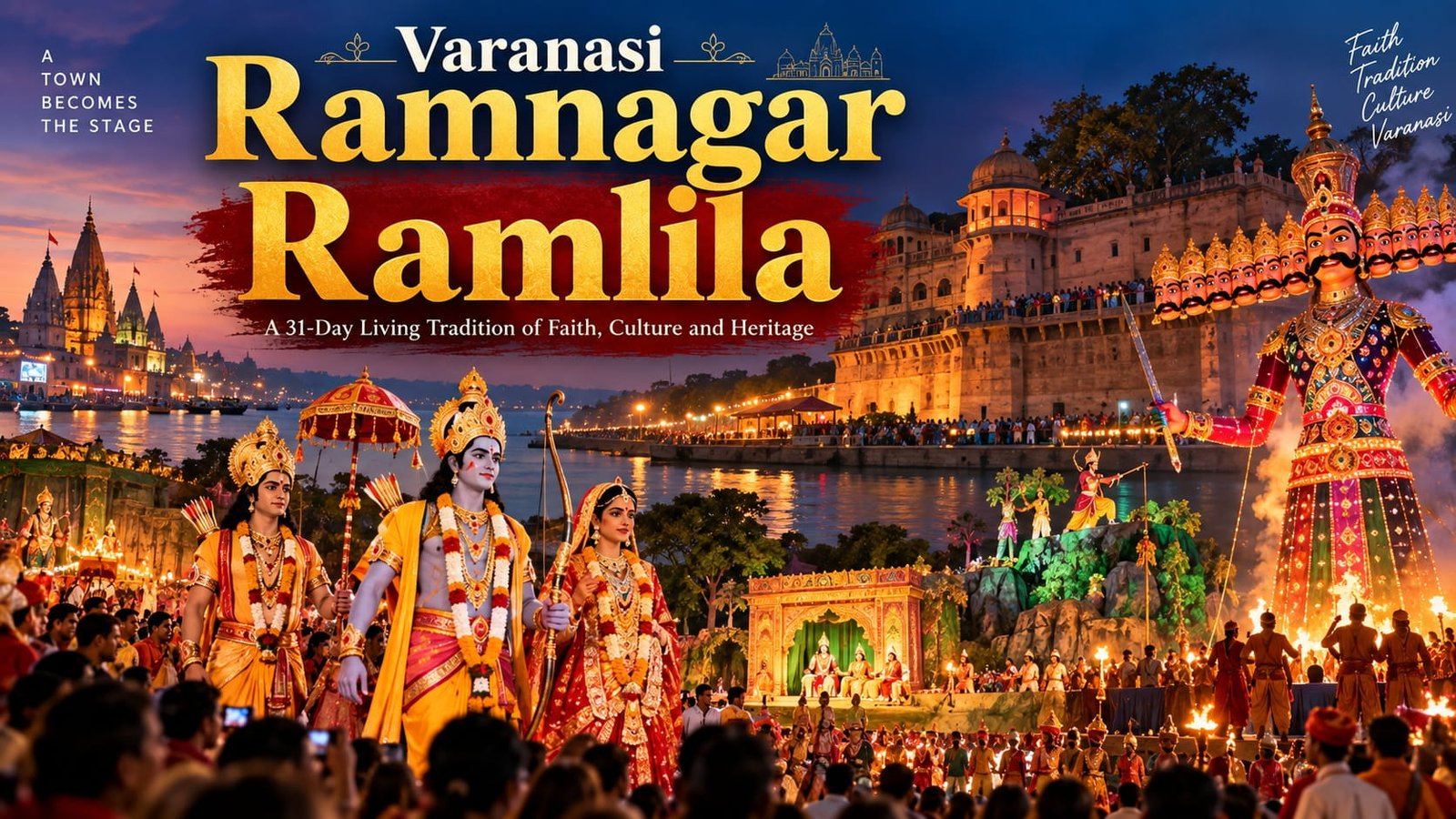
Every autumn, the historic town of Ramnagar, across the Ganga from Varanasi, undergoes an extraordinary transformation. Streets, fields, ponds, temple courtyards and open grounds become Ayodhya, Janakpur, Chitrakoot, Panchavati and Lanka, while thousands of devotees walk from one location to another following the story of Lord Rama.
This is the Ramnagar Ramlila of Varanasi, one of India’s most distinctive living theatrical and religious traditions.
Unlike conventional Ramlila performances held on a single stage for a few evenings, Ramnagar’s version unfolds across an entire town for 31 days. The 2026 edition begins on September 25 and is scheduled to conclude on October 25. The organizing trust has published the month-long programme, with the story beginning from episodes surrounding Ravana’s birth and ultimately concluding with Shri Ram’s later teachings and garden excursion.
UNESCO includes Ramnagar among the representative centres of the broader Ramlila tradition, which was inscribed on the Representative List of the Intangible Cultural Heritage of Humanity in 2008.
Ramnagar Ramlila
| Details | Information |
|---|---|
| Event | Ramnagar Ramlila |
| Location | Ramnagar, Varanasi, Uttar Pradesh |
| Start Date | September 25, 2026 |
| Closing Date | October 25, 2026 |
| Duration | About 31 days |
| Dussehra / Vijayadashami | October 20, 2026 |
| Main Text | Ramcharitmanas |
| Style | Moving, open-air Ramlila |
| Historical Patronage | Kashi Naresh |
| Major Locations | Ayodhya, Janakpur, Chitrakoot, Panchavati, Lanka settings across Ramnagar |
| UNESCO Recognition | Ramlila tradition inscribed in 2008 |
The 2026 schedule has been issued by the Shri Ramlila Maharaj Udit Narayan Singh Manas Prachar Nidhi Trust, according to local reporting.
What Is Ramnagar Ramlila?
Ramlila literally means “Rama’s play.” It dramatizes the life and journey of Lord Rama through narration, dialogue, devotional singing and recitation.
UNESCO explains that Ramlila performances are based largely on the Ramcharitmanas, composed by Goswami Tulsidas in the 16th century. While many Ramlilas last around 10 to 12 days, Ramnagar’s version can continue for an entire month.
What makes Ramnagar unique is that there is no single permanent stage.
Instead, different parts of the town represent different locations from the Ramayana.
When Rama travels from Ayodhya to the forest, the audience moves with the performers. When the story shifts to Janakpur, Panchavati or Lanka, spectators physically travel to another performance site.
In this way, watching Ramnagar Ramlila can feel as much like a pilgrimage through the Ramayana as watching a theatrical production.
Ramnagar Ramlila 2026 Dates
The 2026 Ramnagar Ramlila begins on:
Friday, September 25, 2026
and is scheduled to conclude on:
Sunday, October 25, 2026
Local reporting says the opening performance includes episodes involving Ravana’s birth, his conquests, the Kshir Sagar tableau, prayers of the gods and the divine announcement of Vishnu’s incarnation.
Dussehra falls during the month-long performance rather than serving as the final night.
Dussehra 2026
Tuesday, October 20, 2026
The Ravana-vadh episode is associated with Vijayadashami, after which the Ramlila continues with events surrounding Rama’s return and later episodes.
Ramnagar Ramlila 2026 Important Schedule Highlights
The complete performance contains many episodes, but several dates are particularly useful for visitors planning a trip.
| Date | Major Episode / Occasion |
|---|---|
| September 25 | Ramlila begins; Ravana birth and opening episodes |
| September 30 | Barat departs from Ayodhya; Ram-Sita marriage at Janakpur |
| October 3 | Van Gaman, Nishad Milan and related episodes |
| October 11 | Sharad Navratri period begins |
| October 20 | Dussehra / Ravana Vadh |
| October 21 onward | Events following Rama’s victory and return |
| October 25 | Shri Ram Upvan Vihar, Sanakadi meeting, teachings; scheduled conclusion |
The trust has noted that if rain or another exceptional circumstance prevents a day’s performance, the missed episode may be completed during the following one or two days.
That means travellers visiting for one very specific scene should verify the local programme shortly before attending.
History of Ramnagar Ramlila
Ramnagar’s Ramlila is believed to have developed into its present form under the patronage of the Kashi royal family during the early 19th century.
India’s official tourism portal describes the tradition as centuries old and associated with the patronage of the Kashi Naresh.
Local historical accounts describe a tradition stretching back around two centuries, one that has continued despite enormous changes in transportation, technology and urban life.
The performance’s durability is particularly remarkable because its traditional character remains central to its appeal.
Rather than attempting to turn the production into a modern sound-and-light spectacle, Ramnagar has largely retained an older style of devotional performance.
UNESCO and Ramnagar Ramlila
There is an important distinction when discussing UNESCO recognition.
UNESCO did not separately inscribe only the Ramnagar Ramlila. Instead, it inscribed “Ramlila, the traditional performance of the Ramayana” on its Representative List of the Intangible Cultural Heritage of Humanity in 2008.
UNESCO specifically identifies Ramnagar and Benares/Varanasi among the representative centres of this tradition.
Other representative Ramlila traditions mentioned by UNESCO include those of Ayodhya, Vrindavan, Almora, Satna and Madhubani.
This recognition reflects the significance of Ramlila not merely as entertainment but as a form of oral tradition, performance, community participation and religious expression.
An Entire Town Becomes the Stage
The defining feature of Ramnagar Ramlila is its scale.
Instead of building temporary theatrical scenery, Ramnagar itself becomes the scenery.
Different spaces represent:
- Ayodhya
- Janakpur
- Chitrakoot
- Panchavati
- Kishkindha
- Ashok Vatika
- Lanka
India’s tourism portal describes spectators walking alongside the performers as the action moves through Ramnagar.
This movement changes the relationship between audience and performance.
Visitors are not sitting in numbered seats watching from a distance. They become part of a large moving crowd, travelling through the landscape while the story progresses.
The Ramcharitmanas at the Heart of the Performance
The Ramnagar Ramlila follows Goswami Tulsidas’s Ramcharitmanas, one of North India’s most influential devotional texts.
UNESCO notes that the Ramcharitmanas helped make the story of Rama accessible in a widely understood vernacular form rather than Sanskrit alone.
At Ramnagar, devotees known for following the performance regularly may carry copies of the text and follow the recitation.
The result is a fascinating combination of:
theatre + religious recitation + pilgrimage + public festival
This is one reason simply describing Ramnagar Ramlila as a “play” does not capture the entire experience.
Major Episodes to Watch
If you cannot attend all 31 days, some episodes are especially popular.
Ram-Sita Vivah
The Janakpur scenes surrounding Dhanush Yagya and the wedding of Rama and Sita are among the most celebratory sections.
For 2026, the programme includes the departure of the wedding procession and Janakpur marriage events around September 30.
Van Gaman
The departure of Rama, Sita and Lakshmana into exile is one of the most emotional parts of the Ramayana.
The 2026 schedule places important Van Gaman-related episodes around October 3.
Sita Haran
The abduction of Sita marks the dramatic transition toward the conflict with Lanka.
Lanka Dahan
Hanuman’s journey to Lanka and the burning of Lanka typically creates one of the most visually memorable nights.
Ravana Vadh
The battle reaches its climax on Vijayadashami, when Rama defeats Ravana.
For 2026, Dussehra falls on October 20.
Rama’s Return and Later Episodes
Unlike many Ramlilas that effectively conclude with Ravana’s defeat, Ramnagar continues beyond Dussehra.
The programme ultimately reaches the scheduled closing episodes on October 25.
Ramnagar Fort and the Kashi Naresh Tradition
Ramnagar Fort is an important landmark associated with the town and the royal family of Kashi.
The Kashi Naresh has historically played a significant ceremonial role in the Ramlila tradition.
The royal association gives the festival a distinctive identity compared with neighbourhood Ramlilas organized solely by community committees.
For travellers, combining the Ramlila with a daytime visit to the Ramnagar Fort area can provide useful historical context before the evening performances.
How to Reach Ramnagar Ramlila
Ramnagar lies on the eastern side of the Ganga, opposite central Varanasi.
By road
Visitors can reach Ramnagar by taxi, auto-rickshaw or private vehicle from Varanasi.
Traffic can become extremely heavy on major Ramlila nights, so allow substantially more time than a normal journey.
From Varanasi Junction
Varanasi Junction is one of the main railway stations serving the city.
By air
The nearest airport is:
Lal Bahadur Shastri International Airport, Varanasi
India’s official tourism portal lists this as the principal airport for visitors attending the event. (Incredible India)
What to Expect When You Attend
Do not expect a modern auditorium.
Ramnagar Ramlila is an outdoor public tradition.
You may walk considerable distances and stand for long periods as the performance moves between locations.
Crowds can be large, especially during major episodes around Navratri and Dussehra.
Because the atmosphere is devotional, visitors should also treat the event differently from a regular entertainment show.
Wear modest, comfortable clothes and walking shoes, carry drinking water, and avoid blocking processions or performance routes simply for photographs.
What to Carry
A simple day bag is usually enough.
Useful items include:
- Comfortable walking shoes
- Drinking water
- Light snacks
- Power bank
- Small torch
- Mosquito repellent
- Light shawl for later evenings
- Rain protection if weather remains unsettled
- A copy/app of the Ramcharitmanas if you want to follow the narrative
Avoid carrying unnecessary valuables into very crowded areas.
Photography Tips
Ramnagar Ramlila can be extraordinarily photogenic, but it is first and foremost a living religious tradition.
Avoid flash photography close to performers where it may be disruptive.
A phone or camera capable of handling low light is useful because some parts of the experience preserve a traditional atmosphere rather than using elaborate modern stage lighting.
Wide shots that include performers, devotees and the physical landscape often communicate the character of Ramnagar better than tightly cropped portraits alone.
Combine Ramnagar Ramlila With a Varanasi Trip
Attending Ramlila gives you an excellent reason to explore Varanasi itself.
Popular additions include:
Kashi Vishwanath Temple
One of Hinduism’s most sacred Shiva temples.
Ganga Aarti
The evening ceremony at Dashashwamedh Ghat remains one of Varanasi’s signature experiences.
Sunrise Boat Ride
A dawn boat ride offers one of the best ways to experience the ghats.
Sarnath
The important Buddhist site where Gautama Buddha is traditionally believed to have delivered his first sermon.
Ramnagar Fort
Convenient to combine with the Ramlila side of the river.
India’s tourism portal also recommends combining the festival experience with Varanasi’s ghats, temples, Banarasi silk and local food.
Food to Try in Varanasi
Your trip would be incomplete without exploring local food.
Popular options include:
Kachori Sabzi – classic Varanasi breakfast.
Tamatar Chaat – spicy and tangy Banarasi street food.
Lassi – thick yoghurt drink found throughout the old city.
Malaiyyo – a delicate seasonal milk-based sweet generally associated with the cooler months.
Banarasi Paan – perhaps the city’s most famous after-meal tradition.
Suggested 2-Day Ramnagar Ramlila Itinerary
Day 1 – Classic Varanasi
Start before sunrise with a boat ride along the Ganga.
Visit Kashi Vishwanath Temple and explore the lanes of old Varanasi. Try kachori-sabzi for breakfast and spend part of the afternoon exploring the ghats.
In the evening, watch the Ganga Aarti.
Day 2 – Ramnagar
Cross to Ramnagar earlier in the day.
Explore the fort area, have an early meal and reach the day’s Ramlila location well before the main performance.
Spend the evening following the procession and story.
If you have three or four days, add Sarnath and another night of Ramnagar Ramlila because different episodes can feel completely different.
Ramnagar Ramlila 2026 FAQs
When will Ramnagar Ramlila 2026 start?
The 2026 Ramnagar Ramlila begins on September 25, 2026.
When does Ramnagar Ramlila 2026 end?
The published programme schedules the final episodes for October 25, 2026.
How many days does Ramnagar Ramlila last?
The Ramnagar tradition normally runs for approximately 31 days, much longer than most Ramlilas.
When is Dussehra during Ramnagar Ramlila 2026?
Vijayadashami falls on October 20, 2026, when the Ravana-vadh portion of the story is associated with the Dussehra celebrations.
Where does Ramnagar Ramlila take place?
It is staged throughout Ramnagar on the eastern bank of the Ganga opposite Varanasi, rather than on one fixed theatrical stage.
Is Ramnagar Ramlila a UNESCO World Heritage Site?
More precisely, UNESCO inscribed “Ramlila, the traditional performance of the Ramayana” on the Representative List of the Intangible Cultural Heritage of Humanity in 2008. Ramnagar is specifically identified as one of the representative Ramlila traditions.
Which book is Ramnagar Ramlila based on?
The performance primarily follows Goswami Tulsidas’s Ramcharitmanas.
Is Ramnagar Ramlila held inside Ramnagar Fort?
No. The fort is closely associated with the tradition and royal patronage, but the Ramlila itself uses multiple locations spread across Ramnagar.
What makes Ramnagar Ramlila different?
Its month-long duration, moving audience, multiple real-world performance locations, traditional presentation and strong connection between theatre and devotion distinguish it from most Ramlilas.
Final Words
The Varanasi Ramnagar Ramlila is difficult to understand fully until you experience it.
There is no conventional theatre, no single stage and no audience sitting quietly in rows. Instead, an entire town becomes the world of the Ramcharitmanas, while devotees walk alongside Rama’s journey from Ayodhya through exile, Lanka and eventual return.
In 2026, the 31-day tradition begins on September 25 and is scheduled to conclude on October 25, with Dussehra and Ravana Vadh falling within the month-long cycle on October 20.
For travellers interested in Indian culture, spirituality, history, photography or living heritage, Ramnagar Ramlila offers something increasingly rare: not a recreation of an old tradition for tourists, but a tradition that remains part of the life of the community itself.
And that is what makes Ramnagar Ramlila one of the most extraordinary cultural experiences in Varanasi—and in India.