

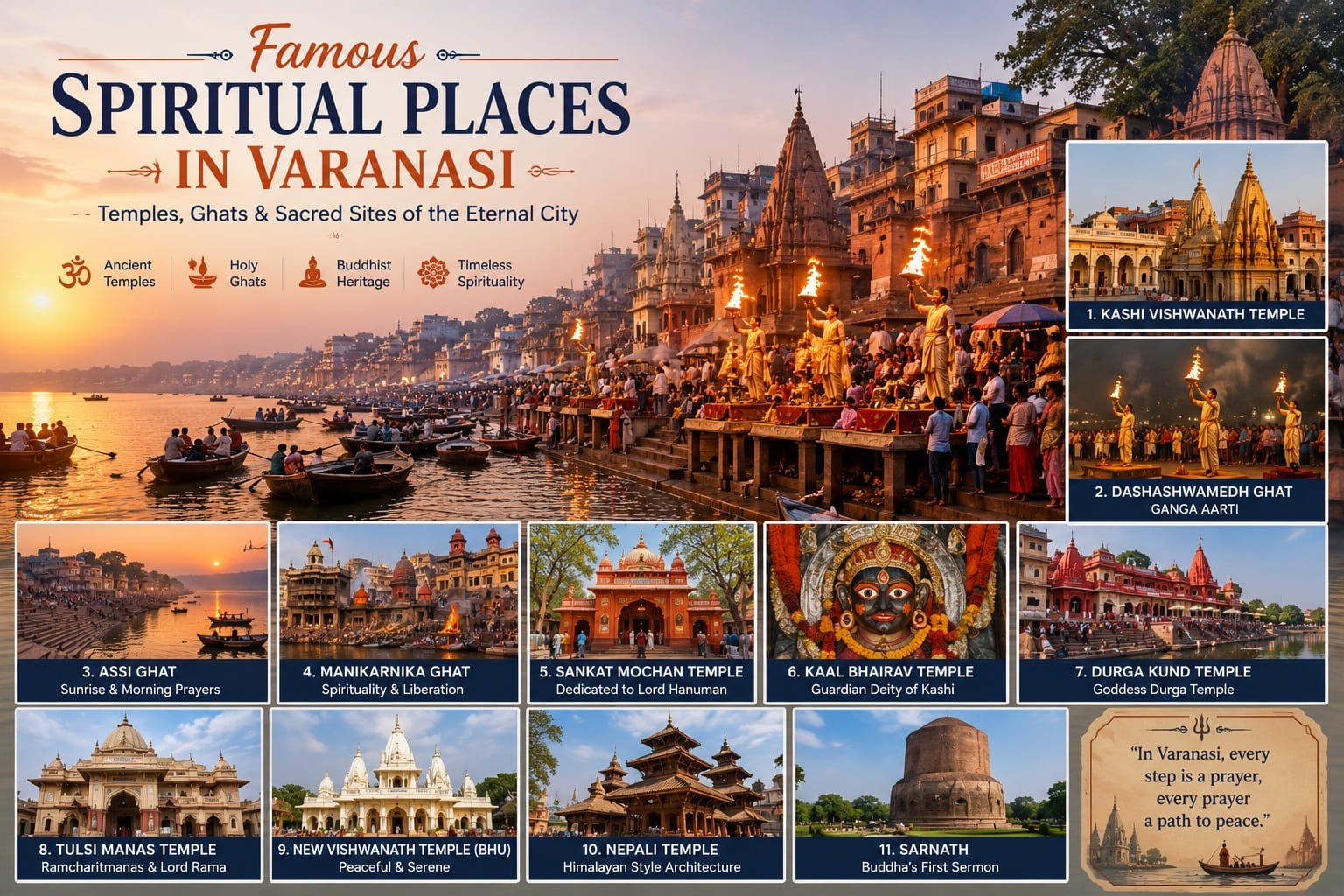
Varanasi, also known as Kashi and Banaras, is one of India’s most important pilgrimage destinations. Located along the sacred River Ganga, the city attracts travellers seeking temple darshan, meditation, ancient rituals and a deeper understanding of Hindu and Buddhist traditions.
The spiritual character of Varanasi can be experienced in its narrow temple lanes, riverside ghats, morning prayers, evening Ganga Aarti and centuries-old pilgrimage routes. The city is especially significant to followers of Lord Shiva, while nearby Sarnath is one of Buddhism’s most sacred destinations.
Famous Spiritual Places in Varanasi
| Spiritual place | Known for | Suggested duration |
|---|---|---|
| Kashi Vishwanath Temple | One of the 12 Jyotirlingas | 1–3 hours |
| Dashashwamedh Ghat | Evening Ganga Aarti | 1–2 hours |
| Assi Ghat | Sunrise rituals and Subah-e-Banaras | 1–2 hours |
| Manikarnika Ghat | Hindu beliefs about life and liberation | 30–60 minutes |
| Sankat Mochan Temple | Temple dedicated to Lord Hanuman | 1 hour |
| Kaal Bhairav Temple | Guardian deity of Kashi | 45–60 minutes |
| Maa Annapurna Temple | Goddess of food and nourishment | 30–45 minutes |
| Durga Kund Temple | Goddess Durga and traditional architecture | 45–60 minutes |
| Tulsi Manas Temple | Ramcharitmanas and Lord Rama | 45–60 minutes |
| New Vishwanath Temple | Peaceful temple inside BHU | 1 hour |
| Nepali Temple | Himalayan-style Shiva temple | 30–45 minutes |
| Sarnath | Buddha’s first sermon and Buddhist monuments | 3–4 hours |
1. Shri Kashi Vishwanath Temple
Shri Kashi Vishwanath Temple is the most famous spiritual place in Varanasi. Dedicated to Lord Shiva, it stands on the western bank of the River Ganga and contains one of Hinduism’s 12 sacred Jyotirlingas.
The presiding deity is known as Vishwanath or Vishveshvara, meaning the “Ruler of the Universe.” Because Varanasi is traditionally called Kashi, the shrine is widely known as Kashi Vishwanath Temple.
The Kashi Vishwanath Corridor has improved access between the temple area and the riverfront, creating wider spaces for pilgrims moving between the ghats and the shrine.
Visitor tips
Visit early in the morning for a comparatively peaceful experience. Security is strict, and mobile phones, cameras, large bags and certain personal belongings may not be permitted inside. Use authorised lockers and follow instructions issued by temple officials.
Darshan procedures, aarti bookings and special arrangements may change during major festivals and the month of Shravan. Confirm the latest information through the official temple portal before visiting.
Best for: Lord Shiva devotees and first-time pilgrims
Nearest major ghat: Lalita Ghat or Dashashwamedh Ghat
Recommended time: Early morning
2. Dashashwamedh Ghat and Ganga Aarti
Dashashwamedh Ghat is the centre of Varanasi’s evening spiritual activity. Every evening, priests perform Ganga Aarti using large brass lamps while mantras, bells and devotional music fill the riverfront.
The ceremony generally lasts around 45 minutes and attracts both devotees and visitors. People watch from the ghat steps or from boats positioned on the Ganga.
Arrive 60 to 90 minutes before the ceremony if you want a clear view from the steps. Boat views can be memorable, but select a licensed operator, agree on the price before boarding and wear a life jacket.
Best for: Evening prayers, photography and cultural experiences
Entry: Free from the ghat
Recommended duration: 1–2 hours
3. Assi Ghat
Assi Ghat is located toward the southern end of Varanasi’s main riverfront and offers a calmer atmosphere than Dashashwamedh Ghat.
It is known for sunrise prayers, yoga sessions, devotional music and the morning cultural programme commonly associated with Subah-e-Banaras. The ghat also provides a convenient starting point for an early-morning boat journey along the Ganga.
Incredible India identifies Assi Ghat as one of the important places for experiencing Varanasi’s living culture and riverside spirituality.
Visit before sunrise to see devotees bathing, priests conducting rituals and the city slowly coming to life. The surrounding area also has cafés, guesthouses and shops, making it a suitable base for travellers.
Best for: Sunrise, meditation, yoga and boat rides
Recommended time: Before sunrise
Suggested duration: 1–2 hours
4. Manikarnika Ghat
Manikarnika Ghat is one of the principal cremation grounds of Varanasi. In Hindu belief, dying or being cremated in Kashi is associated with liberation from the cycle of birth and death.
The ghat offers a powerful reminder of life’s impermanence and Varanasi’s close relationship with death, devotion and moksha. Cremation rituals have been performed here for centuries.
This is an active sacred space rather than a conventional tourist attraction. Visitors should maintain silence, keep a respectful distance and avoid photographing cremations, grieving families or bodies. Do not accept intrusive tours that treat funeral rituals as entertainment.
Best for: Understanding Varanasi’s spiritual philosophy
Important rule: No intrusive photography
Recommended duration: 30–60 minutes
5. Sankat Mochan Hanuman Temple
Sankat Mochan Temple is one of Varanasi’s most respected temples dedicated to Lord Hanuman. Its name refers to Hanuman as the remover of difficulties and protector from trouble.
The temple is traditionally associated with the poet-saint Goswami Tulsidas and is situated near the Assi area on the route toward Banaras Hindu University.
Tuesdays and Saturdays are particularly popular with devotees, so queues may be longer. Visitors often offer flowers and sweets and recite the Hanuman Chalisa.
Monkeys are frequently seen around the area. Keep food securely packed and avoid displaying loose items.
Best for: Lord Hanuman devotees
Recommended time: Early morning
Suggested duration: About one hour
6. Kaal Bhairav Temple
Kaal Bhairav Temple is dedicated to a fierce manifestation of Lord Shiva. In local tradition, Kaal Bhairav is regarded as the “Kotwal of Kashi,” or the spiritual guardian of Varanasi.
Many pilgrims believe that a journey to Kashi is incomplete without seeking Kaal Bhairav’s blessings. The temple is situated near Visheshwarganj and can be included in the same itinerary as Kashi Vishwanath Temple.
The lanes surrounding the temple can become extremely crowded. Travel light, dress modestly and keep footwear and valuables at an authorised counter.
Best for: Traditional Kashi pilgrimage
Recommended duration: 45–60 minutes
7. Maa Annapurna Temple
Located close to Kashi Vishwanath Temple, Maa Annapurna Temple is dedicated to the goddess of food, nourishment and abundance. The district administration lists it among Varanasi’s important temples.
The shrine holds special significance because food is regarded not simply as sustenance but as a divine blessing. Devotees pray here for prosperity and for their homes to remain free from hunger.
Because the temple is close to Kashi Vishwanath, visitors can explore both during the same walking itinerary through the old city.
Best for: Blessings for nourishment and prosperity
Suggested duration: 30–45 minutes
8. Durga Kund Temple
Durga Kund Temple is among Varanasi’s best-known Shakti temples. Dedicated to Goddess Durga, it is recognised for its red-coloured structure and its location beside the sacred pond known as Durga Kund.
The present temple is associated with 18th-century construction and displays features of the North Indian Nagara architectural tradition.
The temple becomes particularly busy during Navratri when devotees arrive to worship the goddess in her different forms. It can be combined with Tulsi Manas Temple and Sankat Mochan Temple, which are located within the same general part of the city.
Best for: Goddess Durga devotees
Recommended duration: 45–60 minutes
9. Tulsi Manas Temple
Tulsi Manas Temple is dedicated to Lord Rama and is associated with the poet-saint Goswami Tulsidas. Tradition connects the area with the composition of the Ramcharitmanas, the celebrated retelling of the Ramayana in the Awadhi language.
Verses from the Ramcharitmanas are inscribed on the temple walls, allowing visitors to combine worship with literary and cultural exploration.
The temple is located close to Durga Kund Temple and can be visited on the same half-day circuit.
Best for: Lord Rama devotees and literary history
Suggested duration: 45–60 minutes
10. New Vishwanath Temple at BHU
The New Vishwanath Temple, sometimes called Birla Temple, is situated within the spacious campus of Banaras Hindu University.
It was planned under the inspiration of Pandit Madan Mohan Malaviya and constructed by the Birla family. Unlike many shrines with restricted entry traditions, the temple was designed to welcome people irrespective of caste or creed.
The peaceful university environment, open courtyards and relatively spacious surroundings make it suitable for visitors seeking quiet prayer away from the dense lanes of old Varanasi.
Best for: Peaceful prayer and family visits
Recommended duration: About one hour
11. Nepali Temple at Lalita Ghat
The Nepali Temple, also known as the Kathwala Temple, is located near Lalita Ghat. Dedicated to Lord Shiva, it is notable for its wooden architecture influenced by the traditional temples of Nepal.
The temple is included among the distinctive spiritual attractions along Varanasi’s riverfront.
Its location makes it easy to combine with Kashi Vishwanath Temple, Lalita Ghat and a walk toward Dashashwamedh Ghat.
Best for: Architecture and quiet contemplation
Suggested duration: 30–45 minutes
12. Sarnath
Sarnath lies approximately 10 kilometres northeast of central Varanasi. It is one of Buddhism’s most important pilgrimage destinations because Gautama Buddha delivered his first teaching there after attaining enlightenment. Buddhist tradition also associates Sarnath with the formation of the early Sangha.
Important places in the Sarnath area include:
- Dhamek Stupa
- Chaukhandi Stupa
- Mulagandha Kuti Vihar
- Archaeological ruins
- Ashokan pillar remains
- Sarnath Archaeological Museum
- Temples established by Buddhist communities from different countries
The Lion Capital originally erected at Sarnath inspired India’s national emblem.
Sarnath is on India’s UNESCO World Heritage Tentative List; it should not yet be described as an inscribed UNESCO World Heritage Site.
Allow at least half a day to explore the archaeological complex, museum and monasteries at a relaxed pace.
Best for: Buddhist pilgrimage, meditation and history
Recommended duration: 3–4 hours
Distance from central Varanasi: Approximately 10 kilometres
Best Spiritual Experiences in Varanasi
Take a sunrise boat ride
An early-morning boat journey offers views of the ghats, temples, pilgrims and daily rituals as Varanasi awakens. Morning boat rides are recognised as one of the city’s most memorable visitor experiences.
Attend the evening Ganga Aarti
The Aarti at Dashashwamedh Ghat combines fire, devotional music, bells and synchronised prayer. Arrive early and choose either a position on the ghat or a boat on the river.
Walk through the old city
A guided spiritual walk can connect Kashi Vishwanath, Annapurna Temple, ancient lanes and nearby ghats. The old city is crowded and easy to get lost in, so a knowledgeable local guide may be useful.
Meditate at Sarnath
Sarnath provides a calmer contrast to central Varanasi. The archaeological gardens and monasteries are well suited to quiet reflection and learning about Buddhist teachings.
Suggested Two-Day Spiritual Itinerary
Day 1: Sacred Ghats and Old Kashi
Begin before sunrise at Assi Ghat and take a boat ride along the Ganga. After breakfast, visit Kashi Vishwanath Temple and Maa Annapurna Temple.
Walk toward Lalita Ghat to see the Nepali Temple. In the late afternoon, explore the riverfront before attending Ganga Aarti at Dashashwamedh Ghat.
Day 2: Temples and Sarnath
Start at Sankat Mochan Hanuman Temple, followed by Tulsi Manas Temple and Durga Kund Temple. Continue to New Vishwanath Temple inside BHU.
Spend the afternoon at Sarnath, visiting Dhamek Stupa, the archaeological remains, Buddhist temples and the museum.
Best Time to Visit Varanasi
October to March generally offers the most comfortable weather for temple visits, heritage walks and boat rides.
April to June can be extremely hot, making early-morning sightseeing preferable. The monsoon season brings humidity and higher river levels, which may affect boat services.
Major occasions such as Mahashivratri, Dev Deepavali, Kartik Purnima and Shravan create an extraordinary atmosphere, but they also bring very large crowds. Incredible India describes Dev Deepavali as one of Varanasi’s most spectacular spiritual celebrations, when the ghats are illuminated with thousands of lamps.
Spiritual Travel Etiquette
Dress modestly when entering temples and religious areas. Remove footwear wherever required and follow instructions concerning photography, electronic devices and security checks.
Ask permission before photographing priests, sadhus or worshippers. Never photograph cremation rituals or grieving families at Manikarnika Ghat.
Do not touch religious objects without permission, and avoid blocking queues while taking photographs. Use authorised priests, guides, boats and donation counters to reduce the risk of scams.
How to Reach Varanasi
Varanasi is accessible by air, rail and road. Lal Bahadur Shastri International Airport serves the city, while Varanasi Junction and Banaras railway stations provide connections with major Indian destinations.
Within the city, visitors commonly use auto-rickshaws, e-rickshaws and taxis. However, many streets near Kashi Vishwanath and the central ghats are pedestrian-only or too narrow for vehicles.
Sarnath is about 10 kilometres from central Varanasi and can be reached by taxi, auto-rickshaw or local transport.
Frequently Asked Questions
Which is the most famous spiritual place in Varanasi?
Kashi Vishwanath Temple is the city’s best-known spiritual attraction. It is dedicated to Lord Shiva and contains one of the 12 Jyotirlingas.
Where is the main Ganga Aarti held?
The best-known evening Ganga Aarti is held at Dashashwamedh Ghat. Assi Ghat is particularly popular for morning spiritual programmes and sunrise rituals.
Is Sarnath part of Varanasi?
Sarnath is situated approximately 10 kilometres northeast of central Varanasi and is administered within the Varanasi district.
Is Sarnath a UNESCO World Heritage Site?
Sarnath is on India’s UNESCO World Heritage Tentative List, but it is not currently an inscribed World Heritage Site.
How many days are enough for a spiritual Varanasi trip?
Two days are sufficient for the principal temples, ghats and Sarnath. Three or four days provide a more relaxed experience with time for meditation, rituals and heritage walks.
Can non-Hindus visit Kashi Vishwanath Temple?
Entry rules and permitted areas can be subject to temple regulations and security procedures. Visitors should confirm the latest guidance through the official temple portal before travelling.
What should visitors wear in Varanasi temples?
Comfortable, modest clothing covering the shoulders and knees is recommended. Footwear must be removed before entering most temple areas.
What is the best time for a boat ride?
Sunrise is generally the most atmospheric time, with cooler conditions and views of morning rituals along the ghats.
Final Thoughts
Varanasi is not defined by one temple or ceremony. Its spiritual identity is spread across Kashi Vishwanath’s sacred Jyotirlinga, the flames of Ganga Aarti, the sunrise atmosphere of Assi Ghat, the philosophy represented by Manikarnika and the Buddhist heritage of Sarnath.
Travellers who approach these places patiently and respectfully will discover more than historic buildings. They will experience a living spiritual tradition in which prayer, music, ritual, philosophy and everyday life remain closely connected.