
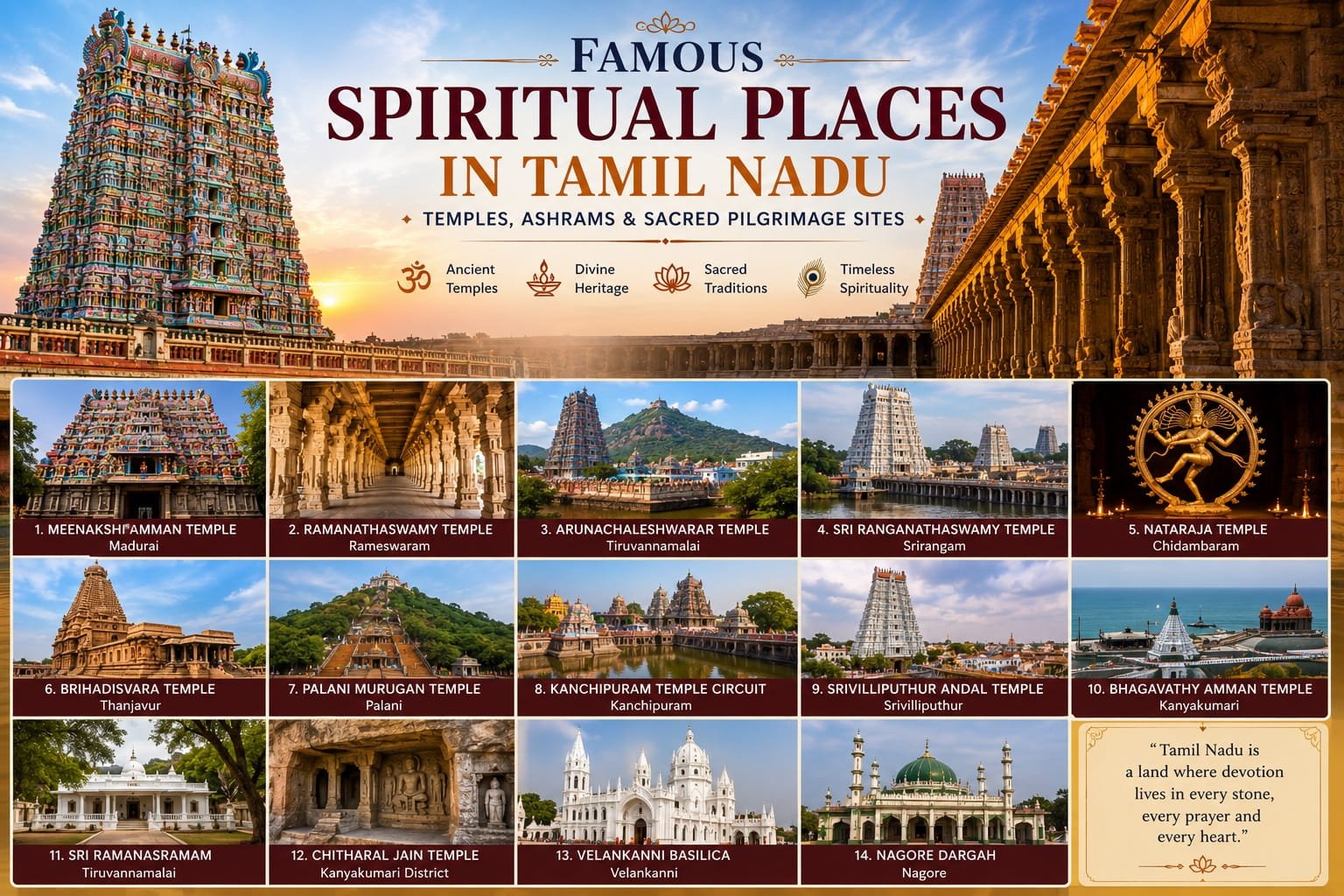

Famous Spiritual Places in Tamil Nadu – Temples, Ashrams and Sacred Pilgrimage Sites
Tamil Nadu is one of India’s greatest spiritual destinations. Its sacred landscape includes ancient Shiva and Vishnu temples, coastal pilgrimage towns, hill shrines dedicated to Lord Murugan, peaceful ashrams, Christian basilicas, Islamic dargahs and historic Jain monuments.
From the colourful towers of Madurai’s Meenakshi Amman Temple to the long corridors of Rameswaram, the sacred hill of Arunachala and the monumental Chola temples around Thanjavur, every region offers a different expression of devotion.
The official Tamil Nadu Tourism pilgrimage directory includes dozens of important temples and sacred centres across the state, reflecting the extraordinary diversity of Tamil Nadu’s religious heritage.
Famous Spiritual Places in Tamil Nadu
| Spiritual place | Location | Famous for |
|---|---|---|
| Meenakshi Amman Temple | Madurai | Goddess Meenakshi, colourful gopurams and Chithirai Festival |
| Ramanathaswamy Temple | Rameswaram | Jyotirlinga, sacred corridors and 22 theerthams |
| Arunachaleswarar Temple | Tiruvannamalai | Lord Shiva, Arunachala Hill and Karthigai Deepam |
| Sri Ranganathaswamy Temple | Srirangam | Major Vishnu pilgrimage centre |
| Nataraja Temple | Chidambaram | Shiva as the cosmic dancer |
| Brihadisvara Temple | Thanjavur | Chola architecture and UNESCO heritage |
| Palani Murugan Temple | Palani | One of Lord Murugan’s six sacred abodes |
| Kanchipuram Temple Circuit | Kanchipuram | Shiva, Vishnu, Shakti and Murugan temples |
| Srivilliputhur Andal Temple | Srivilliputhur | Poet-saint Andal and Vaishnavite tradition |
| Bhagavathy Amman Temple | Kanyakumari | Seaside goddess shrine |
| Sri Ramanasramam | Tiruvannamalai | Meditation and teachings of Ramana Maharshi |
| Chitharal Jain Temple | Kanyakumari district | Rock-cut Jain heritage |
| Velankanni Basilica | Velankanni | Major Christian pilgrimage centre |
| Nagore Dargah | Nagore | Sufi shrine and interfaith devotion |
1. Meenakshi Amman Temple, Madurai
Meenakshi Amman Temple is one of the most famous temples in South India and the spiritual heart of Madurai. The shrine is dedicated to Goddess Meenakshi and Lord Sundareswarar, a form of Lord Shiva.
The temple complex is admired for its 14 gateway towers, sculpted pillars, sacred tank, murals and magnificent Thousand Pillared Hall. Tamil Nadu Tourism notes that the towers rise to approximately 45–50 metres and that the complex contains musical pillars capable of producing different notes.
The most important annual celebration is the Chithirai Festival, which recreates the divine wedding of Meenakshi and Sundareswarar. Navaratri, Avani Moolam and Masi festivals also attract large numbers of devotees.
Best for: Goddess worship, Dravidian architecture and festivals
Recommended duration: Two to three hours
Best visiting time: Early morning or late afternoon
Nearby attractions: Thirumalai Nayakkar Palace, Koodal Azhagar Temple and Tirupparankundram
2. Ramanathaswamy Temple, Rameswaram
Ramanathaswamy Temple is one of Tamil Nadu’s most important Shiva temples and is traditionally recognised as one of India’s 12 Jyotirlinga shrines.
Located on Rameswaram Island, the temple is associated with Lord Rama and the Ramayana. Its principal lingam is traditionally believed to have been created by Goddess Sita, while another lingam was brought by Lord Hanuman.
The temple is particularly famous for its long pillared corridors and its 22 sacred water sources, known as theerthams. Many pilgrims first bathe at Agni Theertham near the seashore and then visit the temple for ritual bathing and darshan.
The official temple portal states that the complex occupies about 15 acres near the Agni Theertham coast and remains closely connected with Ramayana traditions.
Best for: Jyotirlinga pilgrimage and sacred bathing rituals
Recommended duration: Three to four hours
Best season: October to March
Nearby attractions: Agni Theertham, Dhanushkodi and Dr. A.P.J. Abdul Kalam Memorial
3. Arunachaleswarar Temple, Tiruvannamalai
Arunachaleswarar Temple stands at the foot of Arunachala Hill and is one of Tamil Nadu’s most powerful Shiva pilgrimage centres.
Lord Shiva is worshipped here as Arunachaleswarar or Annamalaiyar. The sacred hill itself is revered as a manifestation of Shiva, and devotees undertake Girivalam, a devotional walk around the hill, especially during full-moon nights.
Tamil Nadu Tourism describes the temple as a major example of Chola, Vijayanagara and Dravidian architecture. Its most famous festival is Karthigai Deepam, when a huge ceremonial flame is lit at the top of Arunachala Hill.
The atmosphere during the festival is extraordinary, but crowds can be extremely large. Travellers seeking a quieter experience should visit on a normal weekday.
Best for: Shiva devotion, meditation and Girivalam
Recommended duration: Two to three hours
Best season: November to March
Major festival: Karthigai Deepam
4. Sri Ramanasramam, Tiruvannamalai
Sri Ramanasramam is dedicated to the teachings and legacy of the spiritual teacher Ramana Maharshi.
Located near Arunachala Hill, the ashram attracts visitors interested in meditation, silence, self-enquiry and spiritual study. Important areas include the Samadhi Hall, Old Hall, Matrubhuteswara Shrine, meditation spaces and the path leading toward Skandashram and Virupaksha Cave.
The ashram’s official visitor information emphasises that accommodation is limited and primarily intended for sincere devotees. It also lists celebrations such as Ramana Jayanti, Maha Shivaratri, Guru Purnima and Karthigai Deepam.
Visitors should maintain silence, dress modestly and respect the contemplative environment.
Best for: Meditation and quiet reflection
Recommended duration: One to three hours
Travel tip: Accommodation requests should be made well in advance.
5. Sri Ranganathaswamy Temple, Srirangam
Sri Ranganathaswamy Temple is one of the most important Vishnu temples in India. It is located on the island of Srirangam between branches of the River Kaveri near Tiruchirappalli.
The temple is dedicated to Lord Ranganatha, a reclining form of Lord Vishnu, and is traditionally regarded as the foremost of the 108 Divya Desams.
The official HR&CE portal describes the temple as a vast 156-acre complex with seven concentric enclosures, 52 subsidiary shrines and 21 gopurams. Its monumental Rajagopuram rises to approximately 236 feet.
Vaikunta Ekadashi is the temple’s most celebrated festival and can draw enormous crowds. For a quieter visit, choose a normal weekday and arrive early.
Best for: Vaishnavite pilgrimage and monumental temple architecture
Recommended duration: Two to four hours
Nearby attractions: Rockfort Temple and Jambukeswarar Temple
6. Nataraja Temple, Chidambaram
The Thillai Nataraja Temple in Chidambaram is dedicated to Lord Shiva in the form of Nataraja, the cosmic dancer.
The temple has deep connections with Tamil Shaivism, sacred dance, philosophy and Chola culture. Chidambaram is often called the “Town of the Cosmic Dance,” and the temple remains the city’s main spiritual and historic attraction.
Its most important festivals include Arudra Darisanam and the Natyanjali dance festival. Arudra Darisanam honours Shiva’s cosmic dance, while Natyanjali brings classical dancers together in devotional performance.
Best for: Shiva worship, classical dance and philosophy
Recommended duration: One to two hours
Nearby attractions: Pichavaram mangrove forest and Thillai Kali Temple
7. Brihadisvara Temple, Thanjavur
Brihadisvara Temple, popularly called the Big Temple, is one of India’s greatest architectural and spiritual landmarks.
Dedicated to Lord Shiva, it represents the height of Chola-period temple construction. Its monumental stone tower, sculptures, inscriptions and spacious courtyards continue to attract devotees, historians and architecture lovers.
Brihadisvara Temple forms part of the UNESCO-listed Great Living Chola Temples, together with the temples at Gangaikondacholapuram and Darasuram. UNESCO identifies these three monuments as outstanding 11th- and 12th-century Chola temples.
The temple is especially beautiful during the early morning and around sunset, when the stone structures take on a warm golden colour.
Best for: Shiva devotion, heritage and photography
Recommended duration: Two hours
Nearby attractions: Thanjavur Palace and Saraswathi Mahal Library
8. Palani Dhandayuthapani Swamy Temple
Palani is one of the six sacred abodes of Lord Murugan, collectively known as the Arupadai Veedu.
The Dhandayuthapani Swamy Temple is situated on a hill and can be reached by steps, winch railway or ropeway, depending on operations and availability. The shrine is one of Tamil Nadu’s busiest pilgrimage destinations, particularly during Thaipusam and Panguni Uthiram.
The Dindigul district administration confirms Palani as one of Lord Murugan’s Six Abodes, while Tamil Nadu Tourism currently lists regular temple hours from morning until evening, with earlier opening during major festivals.
Best for: Lord Murugan devotees and hill-temple experiences
Recommended duration: Three to five hours
Travel tip: Expect long queues on festival days and weekends.
9. Kanchipuram Temple Circuit
Kanchipuram is one of Tamil Nadu’s most celebrated temple cities. It offers an extraordinary combination of Shiva, Vishnu, Shakti and Murugan shrines within a relatively compact area.
Important temples include:
- Ekambareswarar Temple
- Kamakshi Amman Temple
- Varadharaja Perumal Temple
- Kailasanathar Temple
- Kumara Kottam Murugan Temple
- Ulagalantha Perumal Temple
Ekambareswarar Temple reflects architectural contributions from the Pallava, Chola and Vijayanagara periods. Varadharaja Perumal Temple is an important Vishnu shrine, while Kumara Kottam is located between the Ekambareswarar and Kamakshi temples, symbolically placing Lord Murugan between Shiva and Parvati.
Best for: A complete multi-temple pilgrimage
Recommended duration: One full day
Best season: October to February
10. Srivilliputhur Andal Temple
Srivilliputhur Andal Temple is one of Tamil Nadu’s most important Vaishnavite pilgrimage centres.
The shrine is closely associated with Andal, the celebrated Tamil poet-saint whose devotional hymns remain central to South Indian Vaishnavite traditions. The temple is also regarded as one of the 108 Divya Desams and is associated with both Andal and Periyalvar.
The temple’s towering gateway is so closely connected with Tamil identity that its form appears in the emblem of the Government of Tamil Nadu.
Best for: Devotion to Goddess Andal and Tamil spiritual literature
Recommended duration: One to two hours
Major festival: Aadi Pooram
11. Bhagavathy Amman Temple, Kanyakumari
Bhagavathy Amman Temple stands beside the sea at India’s southern tip and is dedicated to Devi Kanyakumari.
Its coastal location creates a distinctive atmosphere in which pilgrimage, ocean views and sunrise experiences come together. Tamil Nadu Tourism describes the shrine as a historic seaside temple dedicated to the virgin goddess Devi Kanyakumari.
Visitors commonly combine the temple with Vivekananda Rock Memorial, the Thiruvalluvar Statue and the Kanyakumari sunrise point.
Best for: Goddess worship and coastal spirituality
Recommended duration: About one hour
Travel tip: Dress requirements and rules concerning men’s upper garments may apply in certain temple areas.
12. Chitharal Jain Rock-Cut Temple
Chitharal Jain Rock-Cut Temple is a peaceful spiritual and heritage site in Kanyakumari district.
Set on a green hill, the complex includes a natural rock-cut Jain shrine, ancient inscriptions, stone beds and sculpted reliefs. Tamil Nadu Tourism dates the monument broadly to around the ninth century and notes that Jain monks are believed to have meditated in the surrounding caves.
The climb is moderately demanding, but the quiet setting and panoramic views reward visitors looking for a less crowded spiritual experience.
Best for: Jain heritage, meditation and hill views
Recommended duration: Two hours
Travel tip: Carry water and avoid the hottest part of the day.
13. Velankanni Basilica
The Basilica of Our Lady of Good Health at Velankanni is one of India’s most visited Christian pilgrimage centres.
Located beside the Bay of Bengal in Nagapattinam district, the white Gothic-style basilica welcomes both Christian pilgrims and visitors from other faiths. The district administration describes Velankanni as an internationally visited shrine and notes its importance as a centre of hope and devotion.
The annual festival held around late August and early September is the busiest time of year, with processions, prayers and special services.
Best for: Christian pilgrimage and interfaith spirituality
Recommended duration: Two to three hours
Nearby attraction: Velankanni Beach
14. Nagore Dargah
Nagore Dargah is one of South India’s most important Sufi pilgrimage centres.
The shrine is associated with the 16th-century saint Hazrath Syed Shahul Hameed Quadir Wali. It is known for attracting Muslim, Hindu and other devotees, making it a powerful symbol of shared faith.
The annual 14-day Kandoori Festival includes Quran recitations, processions, ceremonial flag hoisting and the well-known Sandanakoodu procession. Incredible India describes the festival as a gathering that crosses religious boundaries and brings communities together in devotion.
Best for: Sufi heritage and interfaith experiences
Recommended duration: One to two hours
Location: Approximately four kilometres from Nagapattinam
Best Time to Visit Spiritual Places in Tamil Nadu
The most comfortable period for a spiritual tour is generally October to March, when temperatures are comparatively pleasant for walking through large temple complexes.
April to June can be very hot, especially in Madurai, Tiruchirappalli, Thanjavur and Rameswaram. During summer, plan temple visits early in the morning and rest during the hottest afternoon hours.
Festival periods provide unforgettable experiences but also bring heavy crowds. Major pilgrimage occasions include:
- Chithirai Festival in Madurai
- Karthigai Deepam in Tiruvannamalai
- Vaikunta Ekadashi in Srirangam
- Thaipusam in Palani
- Arudra Darisanam in Chidambaram
- Aadi Pooram in Srivilliputhur
- Velankanni Annual Festival
- Nagore Kandoori Festival
Temple schedules, processions and visitor restrictions often change during major festivals, so check official portals before travelling.
Suggested Seven-Day Spiritual Tamil Nadu Itinerary
Day 1: Chennai to Kanchipuram
Visit Ekambareswarar Temple, Kamakshi Amman Temple and Varadharaja Perumal Temple. Continue to Tiruvannamalai in the evening.
Day 2: Tiruvannamalai
Attend early darshan at Arunachaleswarar Temple, visit Sri Ramanasramam and complete part or all of the Girivalam route according to your fitness.
Day 3: Chidambaram and Srirangam
Travel to Chidambaram for Nataraja Temple before continuing to Tiruchirappalli. Visit Srirangam in the evening or early the following morning.
Day 4: Srirangam and Thanjavur
Explore Sri Ranganathaswamy Temple, then travel to Thanjavur for Brihadisvara Temple.
Day 5: Madurai
Spend the day visiting Meenakshi Amman Temple and nearby sacred sites such as Tirupparankundram or Alagar Kovil.
Day 6: Rameswaram
Travel to Rameswaram, visit Agni Theertham and explore Ramanathaswamy Temple.
Day 7: Kanyakumari
Visit Bhagavathy Amman Temple, Vivekananda Rock Memorial and nearby Suchindram. Travellers with additional time can continue to Chitharal.
Spiritual Travel Etiquette
Wear modest clothing that covers the shoulders and knees. Some temples may have additional dress requirements.
Remove footwear only at authorised counters and keep the receipt or token safely. Mobile phones, cameras, leather products and bags may be restricted inside certain temples.
Avoid photographing people during prayer without permission. At churches and dargahs, maintain silence and follow local customs regarding head coverings and designated prayer areas.
Use official donation boxes, ticket counters and temple portals. Be cautious of people offering guaranteed darshan, secret rituals or compulsory donations.
Frequently Asked Questions
Which is the most famous spiritual place in Tamil Nadu?
Meenakshi Amman Temple, Ramanathaswamy Temple, Arunachaleswarar Temple and Srirangam are among the state’s most famous pilgrimage sites.
Which temple in Tamil Nadu is a Jyotirlinga?
Ramanathaswamy Temple in Rameswaram is traditionally recognised as one of the 12 Jyotirlinga temples.
Which Tamil Nadu temples are UNESCO World Heritage Sites?
Brihadisvara Temple in Thanjavur, Gangaikondacholapuram Temple and Airavatesvara Temple at Darasuram form the UNESCO-listed Great Living Chola Temples.
Which spiritual places are best for meditation?
Sri Ramanasramam, Arunachala Hill, Chitharal Jain Temple and quieter areas around Rameswaram are excellent choices for meditation and reflection.
Which city is called the temple city of Tamil Nadu?
Several cities have strong temple identities, but Madurai and Kanchipuram are especially famous for their historic temples. Kumbakonam is also known for its large concentration of sacred sites.
How many days are needed for a Tamil Nadu spiritual tour?
Seven to ten days are ideal for a broad pilgrimage covering Kanchipuram, Tiruvannamalai, Chidambaram, Srirangam, Thanjavur, Madurai, Rameswaram and Kanyakumari.
Are non-Hindus permitted inside all temples?
Access rules differ by temple. Some sanctum areas may be limited to practising Hindus, while outer courtyards or architectural areas may be open more widely. Confirm the latest rules locally and follow instructions from temple authorities.
Final Thoughts
Tamil Nadu’s spiritual landscape is far broader than a list of famous temples. It includes living rituals, sacred hills, devotional poetry, classical music, meditation traditions and pilgrimage centres shared by different communities.
A journey through Madurai, Rameswaram, Tiruvannamalai, Srirangam, Thanjavur and Kanyakumari reveals how deeply spirituality is woven into Tamil culture and everyday life.
Whether you are travelling for prayer, history, architecture or inner peace, the famous spiritual places of Tamil Nadu offer an experience that is both visually magnificent and deeply meaningful.